Framer vs WordPress: Which Is Better for Startup Websites in 2026?

Choosing between Framer and WordPress for your startup website in 2026? This guide breaks down design flexibility, performance, SEO, and cost so you can pick the right platform. Explore Framer templates, Webflow templates, and startup website templates to get started.
Why startup website platform choice matters in 2026
Your website is no longer just a digital business card. In 2026, it functions as your primary sales asset, brand proof, and first impression — often before a prospect speaks to anyone on your team. The platform you build on directly shapes how fast your site loads, how polished it looks, how easily you can update it, and how well it ranks on Google.
Startups face a specific challenge: limited developer resources, tight timelines, and high design expectations. You need a platform that lets a small team move fast without accumulating technical debt.
Framer and WordPress represent two very different answers to that challenge. Both are capable. Both have their place. Which one is right depends on what you're actually building, who's maintaining it, and how much complexity you're willing to manage.
What is Framer?
Framer is a visual website builder built for modern brands, launched originally as a design prototyping tool and since evolved into a full-featured website platform. It combines a pixel-level visual editor with clean code output, built-in hosting, and a CMS designed for marketing teams.
What makes Framer different:
No plugins required — most functionality is built in
Visual canvas with real code output, not div-soup from a page builder
Animations and interactions built natively, not bolted on via JavaScript libraries
Managed hosting with global CDN, automatic SSL, and zero server configuration
CMS editor that preserves design constraints even for non-technical editors
One-click template duplication with live preview before purchase
Framer is particularly popular with SaaS companies, design agencies, and solo founders who want a site that looks like it was built by a senior designer, without needing one on-call permanently.
Pentaclay is an Official Framer Partner with one of the largest libraries of premium Framer templates available. If you want to launch on Framer fast, browse our Framer templates across SaaS, agency, local business, and more.
What is WordPress?
WordPress is the world's most widely used content management system, powering roughly 43% of all websites as of 2026. It started as a blogging platform in 2003 and has since grown into a highly flexible open-source CMS with a massive plugin ecosystem, a global developer community, and deep integration with virtually every third-party tool imaginable.
What makes WordPress powerful:
Over 60,000 plugins covering nearly every feature imaginable
Flexible content models via custom post types and fields
Large pool of available developers at competitive rates
Full support for complex editorial workflows
Headless configuration available for React-based frontends
WooCommerce for e-commerce at scale
WordPress is the right choice when you need the ecosystem. It is not the right choice when you need simplicity.
Framer vs WordPress: side-by-side comparison
Feature | Framer | WordPress |
Design control | Visual canvas, pixel-level | Themes + page builders |
Page speed | Fast by default | Requires optimization |
SEO tools | Built-in meta, sitemap, redirects | Yoast / Rank Math plugin |
Security | Managed, zero plugin risk | Ongoing patch management |
Hosting | Included in plan | Separate (Kinsta, WP Engine, etc.) |
CMS editor | Constrained, design-safe | Gutenberg (flexible but breakable) |
Plugin ecosystem | Limited, growing | 60,000+ plugins |
Developer availability | Fewer, more specialized | Abundant, lower cost |
Learning curve | Low for designers | Moderate, high with custom builds |
Monthly cost (starter) | From $20/month all-in | $30–$150+/month (hosting + plugins) |
Design and customization
Framer
Framer gives you visual control at the component level. You work on a canvas that mirrors what your site actually renders — there is no translation layer between your design and the output. Animations, scroll triggers, hover states, and responsive breakpoints are all configured visually. The result is that what you build in Framer looks like what you designed, without compromise.
Premium Framer templates from Pentaclay include responsive layouts, pre-built CMS collections, and animations out of the box — which means you can go from template to live in hours, not days.
WordPress
WordPress customization depends heavily on your chosen theme and page builder. Popular options like Elementor, Divi, and Bricks give you a drag-and-drop interface but generate bloated HTML that can hurt performance and make future redesigns painful. Getting a WordPress site to precisely match a Figma design requires significantly more developer time than the equivalent in Framer.
Verdict:
Framer wins for design fidelity and visual control. WordPress wins for structural flexibility when your content model is highly complex.
Performance and page speed
Framer
Framer outputs clean, minimal HTML and CSS. There are no unused plugin stylesheets, no JavaScript libraries loaded by widgets you didn't activate, and no unoptimized images slipping through without compression. Core Web Vitals on Framer sites are consistently strong out of the box, with LCP under 2.5 seconds being the norm rather than the exception on a well-built template.
WordPress
A WordPress site can be fast — but it rarely is by default. Every plugin adds HTTP requests, JavaScript, and CSS to your page load. Performance optimization typically requires a dedicated caching plugin (WP Rocket, W3 Total Cache), image compression (Smush, Imagify), CDN configuration, and careful plugin auditing. Managed WordPress hosts like Kinsta and WP Engine help significantly but add to monthly costs.
Verdict: Framer wins on performance out of the box. WordPress can match or exceed it with the right configuration, but that configuration takes time and expertise.
SEO capabilities
Framer
Framer includes native controls for meta titles, meta descriptions, Open Graph tags, canonical URLs, XML sitemaps, and 301 redirects — all manageable without a plugin. Schema markup (JSON-LD) can be added via Embed components. Framer's clean code structure means search engines parse pages cleanly, with no conflicting plugin output to contend with.
For Pentaclay's own site, we run a sophisticated SEO architecture on Framer with hub pages, pillar content, and full JSON-LD schema — proof that Framer can compete at the highest level of technical SEO.
WordPress
WordPress's SEO story depends almost entirely on Yoast or Rank Math. Both are excellent tools with deep functionality — content analysis, schema support, redirect managers, breadcrumbs, and more. For SEO-heavy sites with large content operations, WordPress's SEO plugin ecosystem is genuinely more mature than Framer's current native feature set.
Verdict: WordPress has a slight edge on advanced SEO tooling via plugins. Framer's native SEO tools cover everything a startup needs and remove plugin dependency risk.
Security and maintenance
Framer
Framer handles all hosting infrastructure, SSL certificates, CDN configuration, and security patching. There is nothing to update, no plugins to audit for vulnerabilities, and no server to misconfigure. For a small team without a dedicated developer, this is a meaningful operational advantage.
WordPress
WordPress's security surface is large. The core software is reasonably secure, but plugins are where most vulnerabilities live — and 60,000+ plugins with varying maintenance quality creates real risk. Automated attacks against WordPress installations are common. Managing security on WordPress requires either a managed host (Kinsta, WP Engine) with proactive scanning, or a developer monitoring updates and running audits.
Verdict: Framer wins on security and maintenance simplicity. WordPress requires ongoing attention that many startups underestimate.
Cost of ownership
Let's compare real annual costs at startup scale:
Framer (Mini or Basic plan):
Framer plan: $20–$35/month
Premium template (one-time): $49–$89
Custom domain: ~$15/year
Total Year 1: ~$290–$510
WordPress (equivalent quality):
Managed hosting (Kinsta Starter): $35/month
Premium theme: $59–$200 one-time
Essential plugins (Yoast, WP Rocket, Smush, etc.): $100–$200/year
SSL, backups, security plugin: included or $50–$100/year
Developer time for setup and customization: $500–$2,000+
Total Year 1: ~$1,200–$3,000+
The gap widens when you factor in the hidden cost of WordPress maintenance — plugin conflicts, update testing, and the occasional emergency fix.
When to choose Framer
Framer is the stronger choice when:
You want a modern, design-forward site without a developer on payroll
Your site is primarily a marketing or landing page destination, not a large content archive
Speed of launch matters — a premium Framer template lets you go live in hours
You care deeply about page speed, clean code, and consistent visual output
Your team is non-technical and needs an editor that won't let them break the design
You're a SaaS, agency, consultancy, or local business building a credibility-first web presence
Explore Pentaclay's Framer templates across 15+ industries, starting from $39.
When to choose WordPress
WordPress is the stronger choice when:
You're running a large-scale content operation with multiple authors, editorial workflows, and a high post volume
Your site requires complex membership, gating, or e-commerce functionality via WooCommerce
You have a WordPress developer on your team who knows the ecosystem well
You need deep third-party integrations that don't yet have Framer equivalents
You're pursuing a headless architecture with a custom React or Next.js frontend
Best Framer templates for startup websites
If you've decided Framer is the right platform, a premium template is the fastest way to launch. Every Pentaclay template includes responsive layouts, pre-built CMS collections, and full documentation. Prices start from $39.
Top picks for startups:
SaaS Framer template — Built for SaaS landing pages with feature sections, pricing tables, and testimonials
Agency Framer template — Portfolio and services layout for creative and digital agencies
Startup Framer template — Clean, conversion-focused layout for early-stage products
Business Framer template — Professional multi-page layout for established businesses
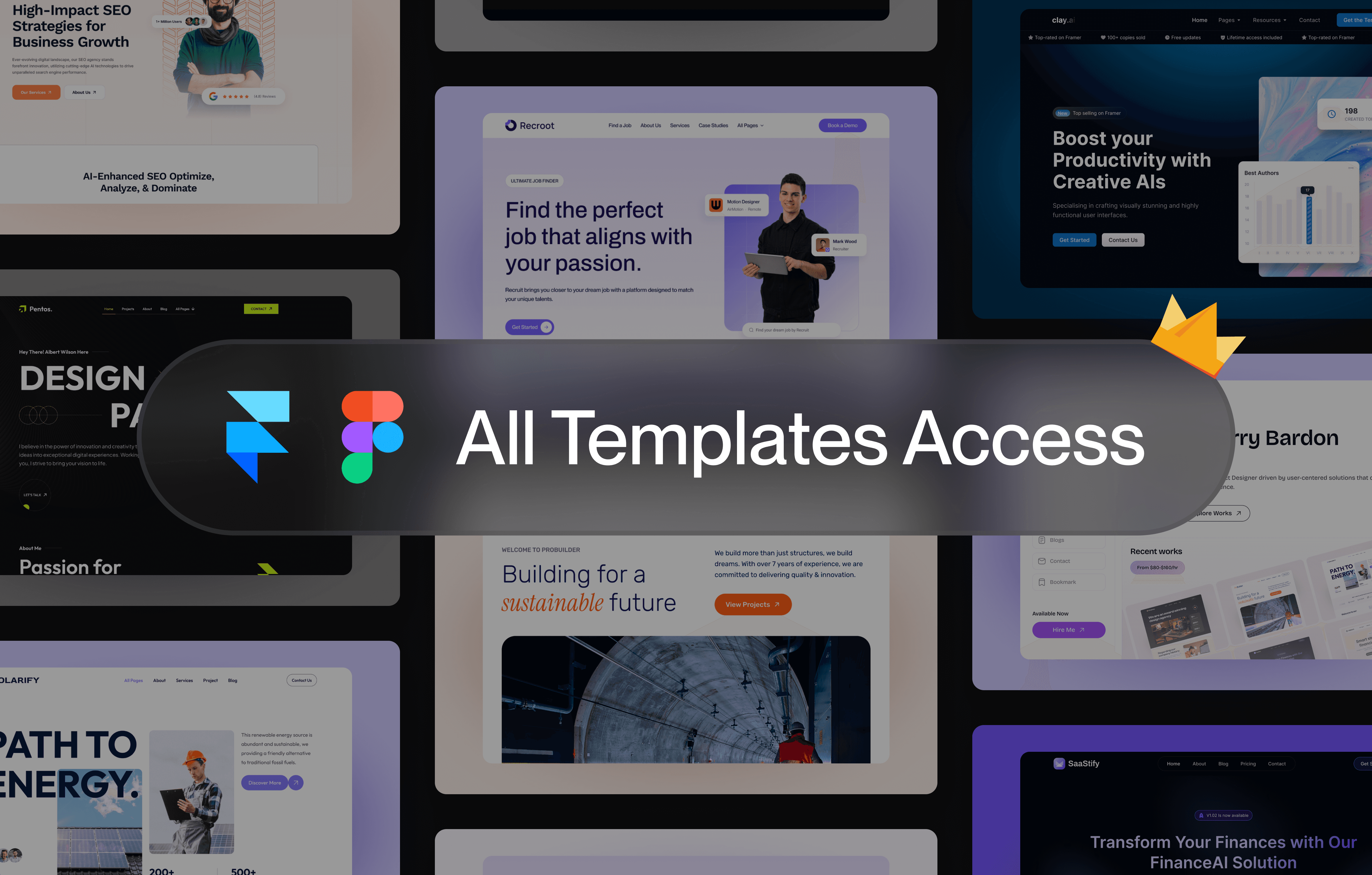
Or get access to the full library with the Pentaclay All Access plan — unlimited template downloads from $99/year.
FAQs: Framer vs WordPress
Is Framer good for SEO?
Yes. Framer includes native meta tag controls, XML sitemaps, canonical URLs, 301 redirects, and clean semantic HTML output. You can add JSON-LD schema via Embed components. For startup marketing sites, Framer covers every technical SEO requirement without needing a single plugin.
Can Framer replace WordPress?
For most startup marketing websites, landing pages, and portfolio sites — yes. If your site depends on complex plugin functionality, large editorial workflows with multiple authors, or WooCommerce for e-commerce, WordPress still has advantages Framer doesn't yet match.
Is Framer free to use? Framer has a free plan with a Framer subdomain. To use a custom domain and unlock CMS and advanced features, paid plans start at $20/month. Most startups opt for the Mini or Basic plan.
Which is faster to launch — Framer or WordPress?
Framer is significantly faster to launch, especially with a premium template. A Pentaclay Framer template can be customized and live on a custom domain within a day. An equivalent WordPress site, configured properly with the right theme and plugins, typically takes several days to a week.
Does Framer work for blogs?
Yes. Framer's CMS supports blog post collections with tags, categories, author fields, and dynamic layouts. It is not as feature-rich as WordPress for large editorial operations, but it handles a typical startup blog well.
What happens to my Framer site if I cancel my plan?
Your site will go offline if you downgrade from a paid plan. Framer does not export static HTML in the same way WordPress allows you to migrate your database. Factor this into your platform decision if portability is a priority.
Pentaclay is an Official Framer Partner. We build premium Framer and Webflow templates for startups, SaaS companies, agencies, and local businesses. Browse our full template library or hire our Framer experts to build your custom site.