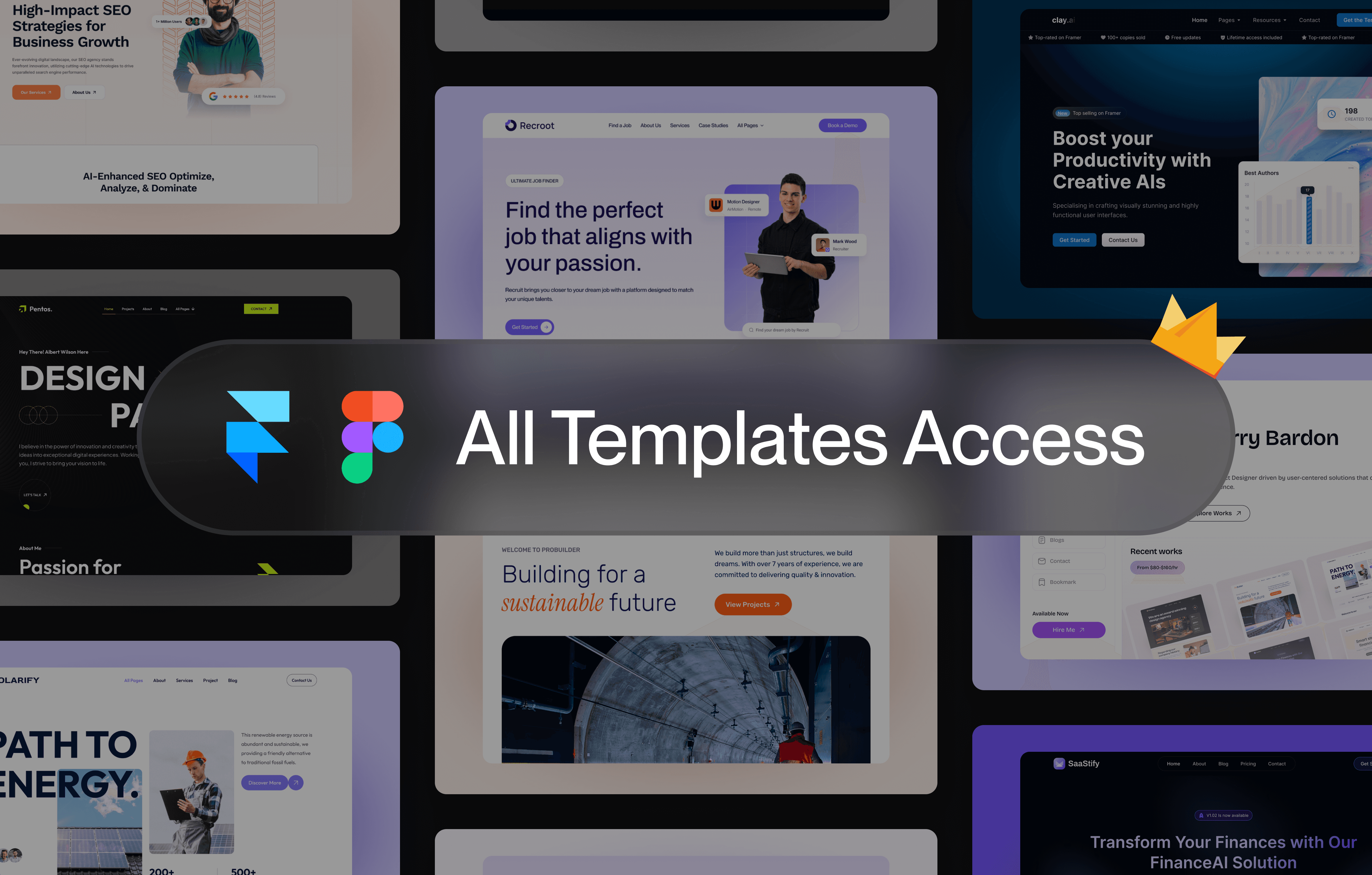
Best Framer Templates
Looking for the best Framer templates to launch your website faster and convert more visitors? Whether you want to buy Framer templates for a SaaS product, agency, or startup, explore premium Framer website templates built for real business goals, or find the best Framer templates for startups and agencies with conversion-ready structure — this is the complete Pentaclay library. Browse by category, compare by use case, and launch in days — from free to $99.

Why the Right Framer Template Changes Everything
Building a website in Framer from scratch takes weeks. Starting with the wrong template takes just as long once you realize the structure does not fit your product, your buyer, or your conversion goals. The right Framer template collapses that timeline — giving you a professionally designed foundation built for performance, conversion, and scalability from the very first page.
Modern premium Framer website templates are more than design assets. They include structured layouts engineered around how real buyers evaluate products, conversion-focused sections placed at the right moments in the scroll, CMS infrastructure for long-term content growth, and component systems that make brand customization fast and consistent across every page. From clean SaaS landing pages to editorial agency portfolios to fintech dashboards, the right template gives you a starting point that is already 80% of the way to launch — so you can spend your time on the 20% that is uniquely yours.
This page covers the complete Pentaclay Framer template library organized by category and use case. Whether you are launching your first product, rebuilding an established agency website, or building client sites across a portfolio, this is your complete reference for finding the right template, understanding what makes it the right choice for your specific situation, and getting to a live site faster than starting from scratch would allow.
Browse Framer Templates by Use Case
The fastest way to find the right template is to start with your use case rather than browsing by design preference. A template that looks excellent but is structured for the wrong conversion goal will cost you leads, time, and credibility.
For SaaS products — you need structured layouts that explain features clearly, guide users through a logical product narrative, and drive trial signups or demo requests. Browse the best Framer SaaS templates for options built specifically around the SaaS buyer journey.
For agencies and studios — the focus shifts to showcasing work, building trust, and generating qualified client inquiries. Browse the best Framer agency templates for portfolio-driven options with case study layouts and lead capture flows.
For startups at the early stage — speed of launch and messaging flexibility matter most. Browse the best Framer startup templates for options that get you from purchase to published in a weekend without sacrificing credibility.
For AI products — you need product storytelling structure, visual proof sections, and trust signal architecture specific to AI buyers. Browse the best Framer AI templates for options purpose-built for AI product categories.
For portfolio and creative work — visual-first layouts, case study depth, and personal brand expression sections matter more than conversion optimization. Browse the best Framer portfolio templates for options matched to your creative discipline.
For creators and personal brands — audience-building, newsletter capture, and personal brand expression are the primary goals. Browse Framer templates for creators for storytelling-first options built around owned audience growth.
Quick Reference — Best Template by Goal
Goal
Best Templates
Why
B2B SaaS launch
Arcedia, EventIQ
Enterprise structure, demo CTA
AI product website
ClayAI, Chatpilot
Product UI hero, AI buyer trust
Creative agency
Rendani, Mitaly
Portfolio-first, editorial identity
Performance marketing agency
Converra, Optimo
Results-led, outcome framing
Tech agency
Mithcy, Codot
Dual-audience, developer aesthetic
Luxury studio
Studio Velvoe
Premium restraint, exclusivity
Startup MVP launch
Systema, Redient
Speed, flexibility, credibility
Crypto / Web3 startup
Cryptoclay
Web3 trust signals, futuristic UI
Fintech product
Banki, Saatify
Financial credibility, dashboard UI
Productivity SaaS
Taskible, Gilberto
Clarity, differentiation structure
Photography portfolio
Marlowe
Full-width, session navigation
Product designer portfolio
Hyperfolio
UX-forward, availability signal
Free starting point
Portox, Pentos, Codot
No cost, professional quality
What Makes a Great Framer Template
A great Framer template goes beyond aesthetics. It is built around real-world business goals, buyer psychology, and the specific conversion challenges of the product or service category it serves. Here are the five qualities that separate the best Framer templates from visually impressive ones that do not perform.
Conversion-first page architecture. Every section should have a defined purpose tied to a specific stage of the buyer's decision-making process. Hero sections that prioritize visual decoration over value proposition clarity are common in low-quality templates and consistently underperform. Strong templates lead with the outcome, support it with proof, and present the CTA at every natural decision point in the scroll.
Product storytelling structure. Whether you are selling SaaS software, creative services, or a physical product, your website needs to guide visitors from the problem they recognize to the solution you offer to the specific outcome they can expect. Templates with structured storytelling sections — problem, solution, proof, CTA — consistently outperform templates that present features without narrative context.
CMS infrastructure for long-term growth. Content marketing is the most cost-effective long-term acquisition channel for most businesses. Templates with pre-configured Framer CMS collections for blog posts, case studies, portfolio projects, and product updates give you the infrastructure to build organic authority from day one without rebuilding your site structure later.
Responsive design and performance. Your audience accesses your site from multiple devices. Templates built with clean Framer code and performance-optimized design deliver consistent experiences across mobile, tablet, and desktop while supporting strong Core Web Vitals scores — which protects both user experience and search rankings simultaneously.
Customization flexibility without structural compromise. The best templates provide a solid structural foundation while allowing meaningful brand customization. Framer's component system means color, typography, and logo changes propagate across all pages when the template is built correctly — making brand-level customization fast without introducing visual inconsistencies.
Framer Agency Templates
Agency websites serve one primary goal: converting a qualified visitor into a client inquiry. Every design decision, every section, every CTA placement should serve that goal. The best Framer agency templates are built around that specific conversion challenge — not just around looking impressive in a screenshot.
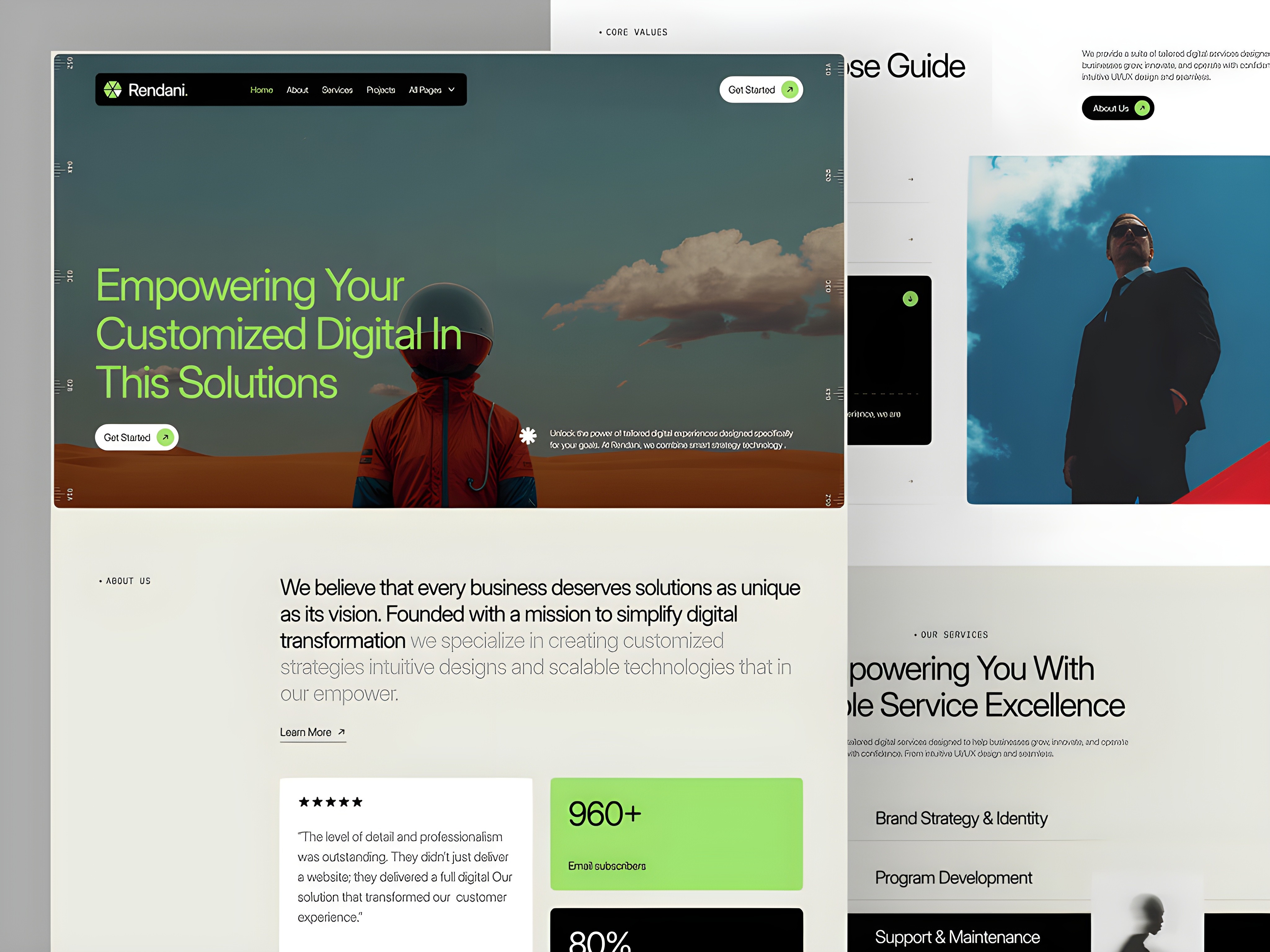
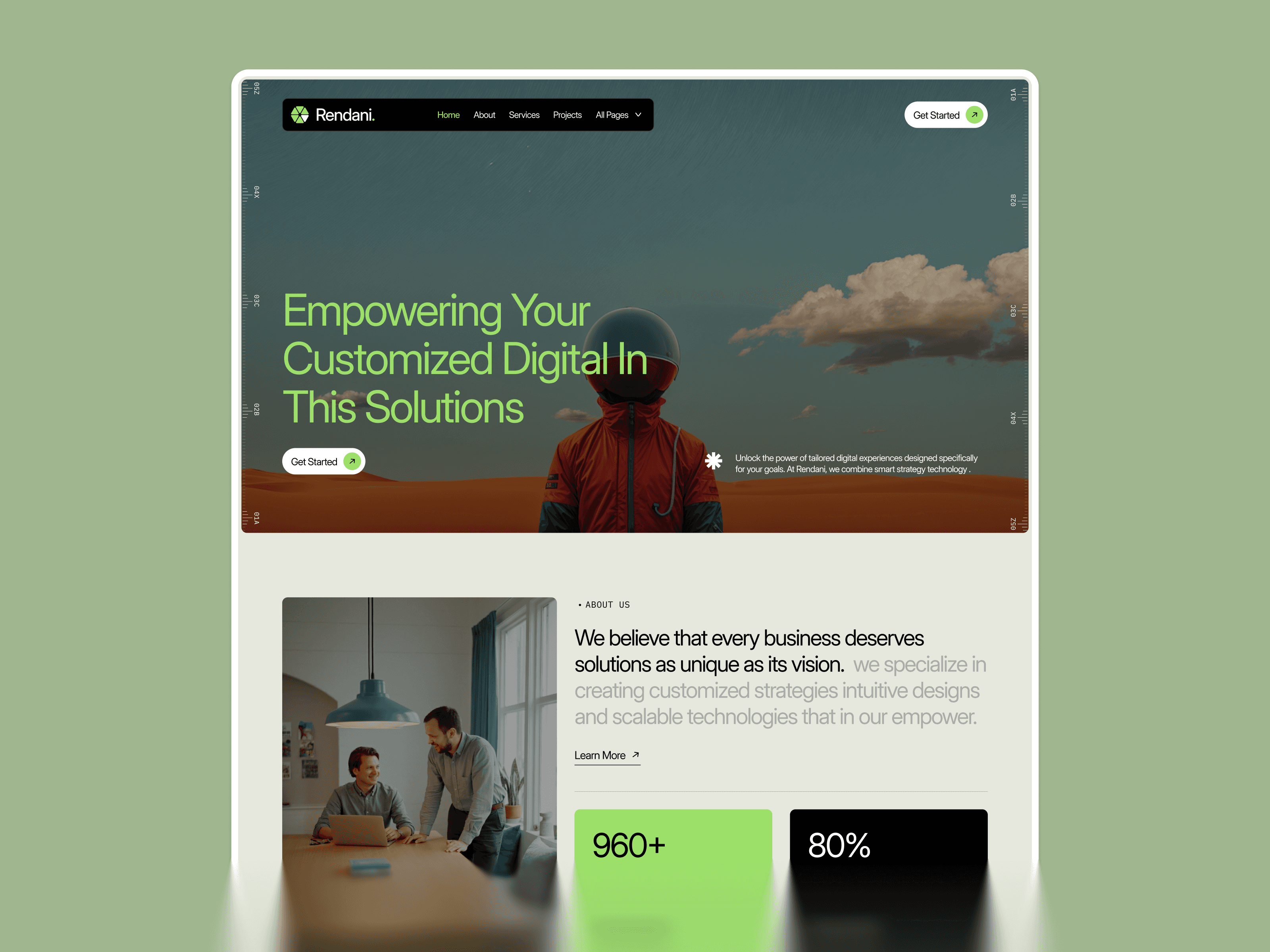
Rendani is the most structurally complete agency template in the Pentaclay library — built for full-service creative agencies and marketing studios that need to communicate both individual creative talent and organizational credibility simultaneously. The template carries case study depth, team credentials, client testimonials, and a portfolio grid in a single cohesive design system that positions your agency at the studio level rather than the solo freelancer level.
Best for: Full-service creative agencies, marketing studios pitching enterprise clients, senior creative directors building studio-level positioning.
Why it stands out: It is the only template in the collection built to carry both individual creative identity and organizational credibility in the same page structure — the combination that converts enterprise clients.
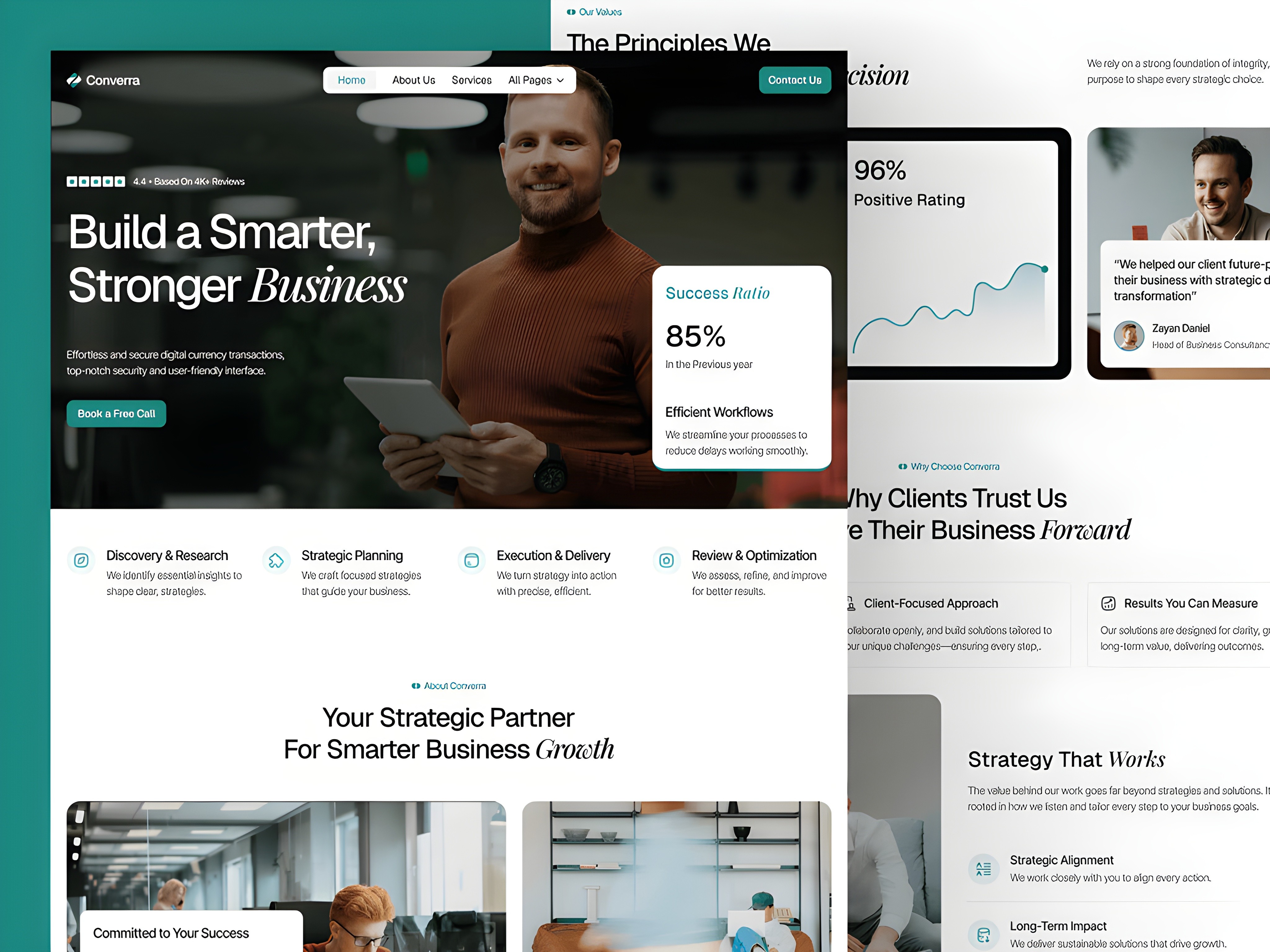
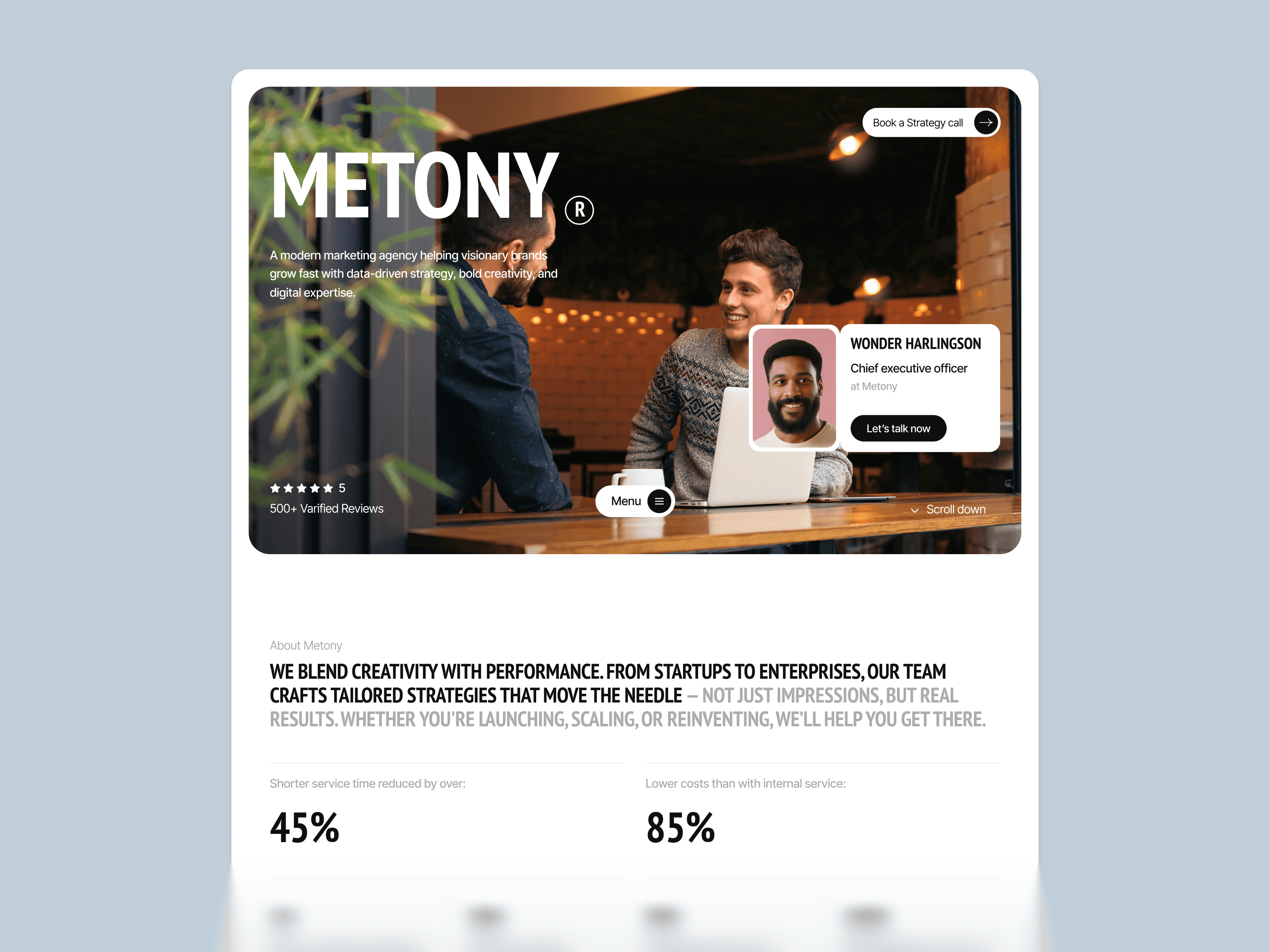
Converra is built for performance marketing agencies, growth studios, and digital consultancies whose sales argument is measurable results rather than creative quality. The page architecture leads with outcomes — case study results, ROI metrics, client retention — which is the correct conversion sequence for a performance agency where clients are buying proof, not process.
Best for: Performance marketing agencies, paid media studios, SEO and content agencies, growth hacking consultancies.
Why it stands out: Where most agency templates are built for portfolio-driven creative businesses, Converra is built for results-driven service businesses where data closes deals.
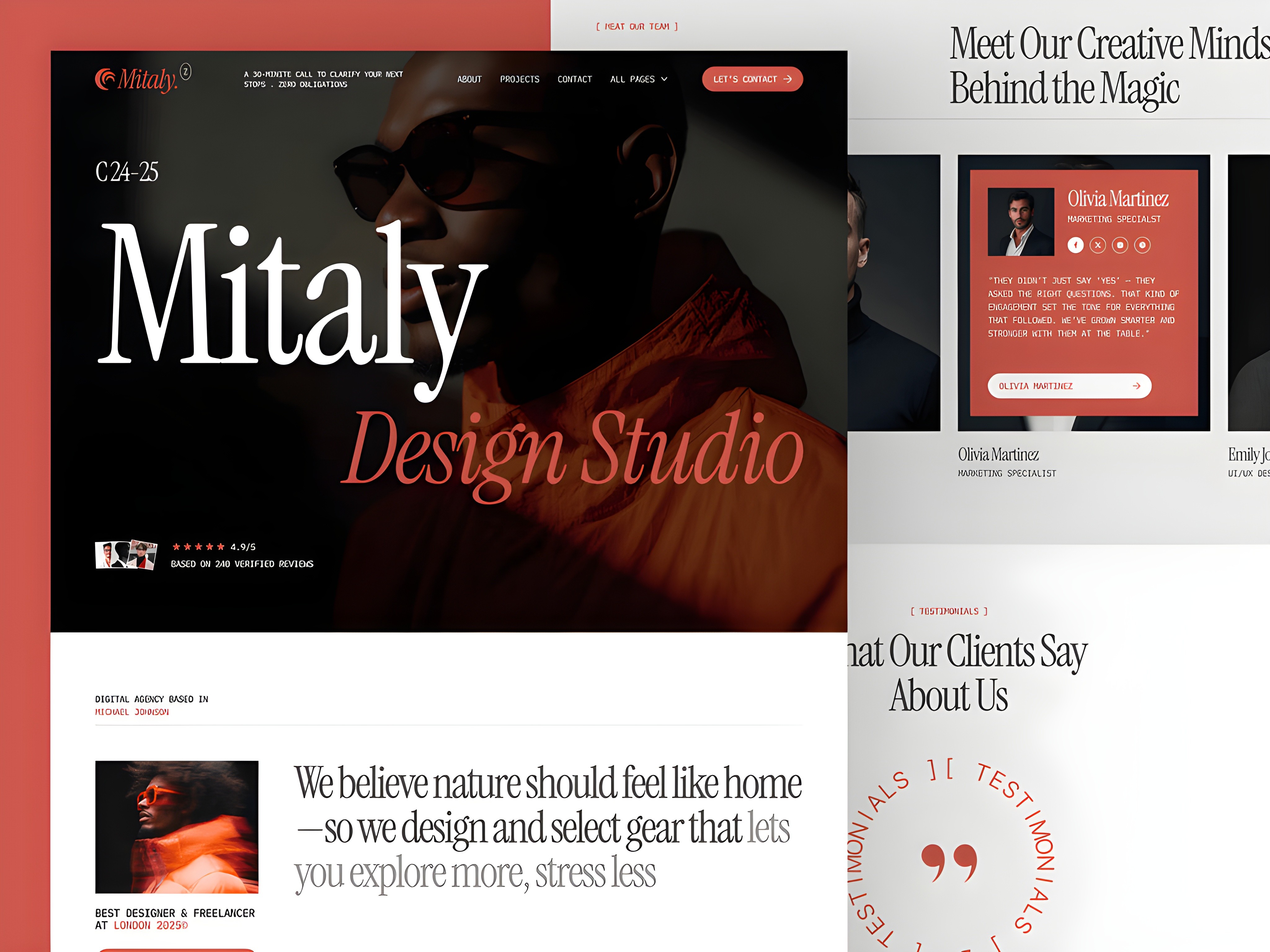
Mitaly is purpose-built for design studios and creative agencies with a strong editorial brand identity. The dark red and black design system is deliberately bold and opinionated — communicating that your studio has a genuine aesthetic perspective, not just a list of services. The philosophy and brand story sections give you structural space to express the specific point of view that differentiates your studio from every other creative business making similar claims about quality and craft.
Best for: Design studios with a strong visual identity, branding agencies, creative practices with a distinctive aesthetic philosophy.
Why it stands out: The most visually opinionated template in the collection — the right choice for studios that know exactly who they are and want a website that reflects that with conviction.
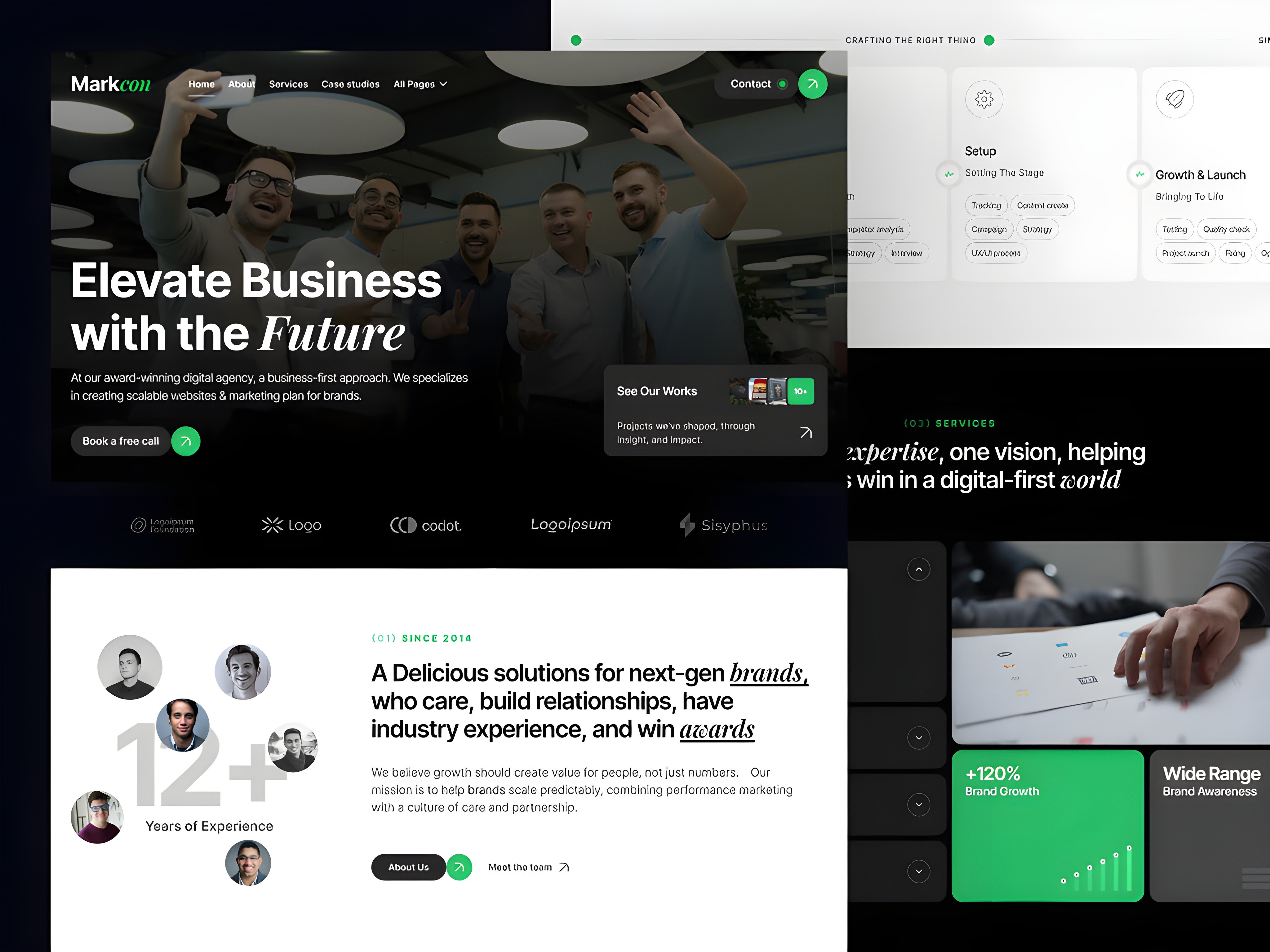
Markcon is a structured, business-focused agency template built for marketing agencies, consulting firms, and B2B service providers whose clients evaluate agencies on clarity and professionalism before creative quality. The clean content hierarchy, service-focused page layout, and conversion-oriented CTA structure are all engineered for business buyers who need to understand what your agency does and why it matters — quickly and without visual distraction.
Best for: B2B marketing agencies, business consulting firms, strategy and advisory practices, professional services.
Why it stands out: Built for the agency whose clients are business buyers rather than design buyers. Clarity closes deals faster than creativity in B2B service sales.
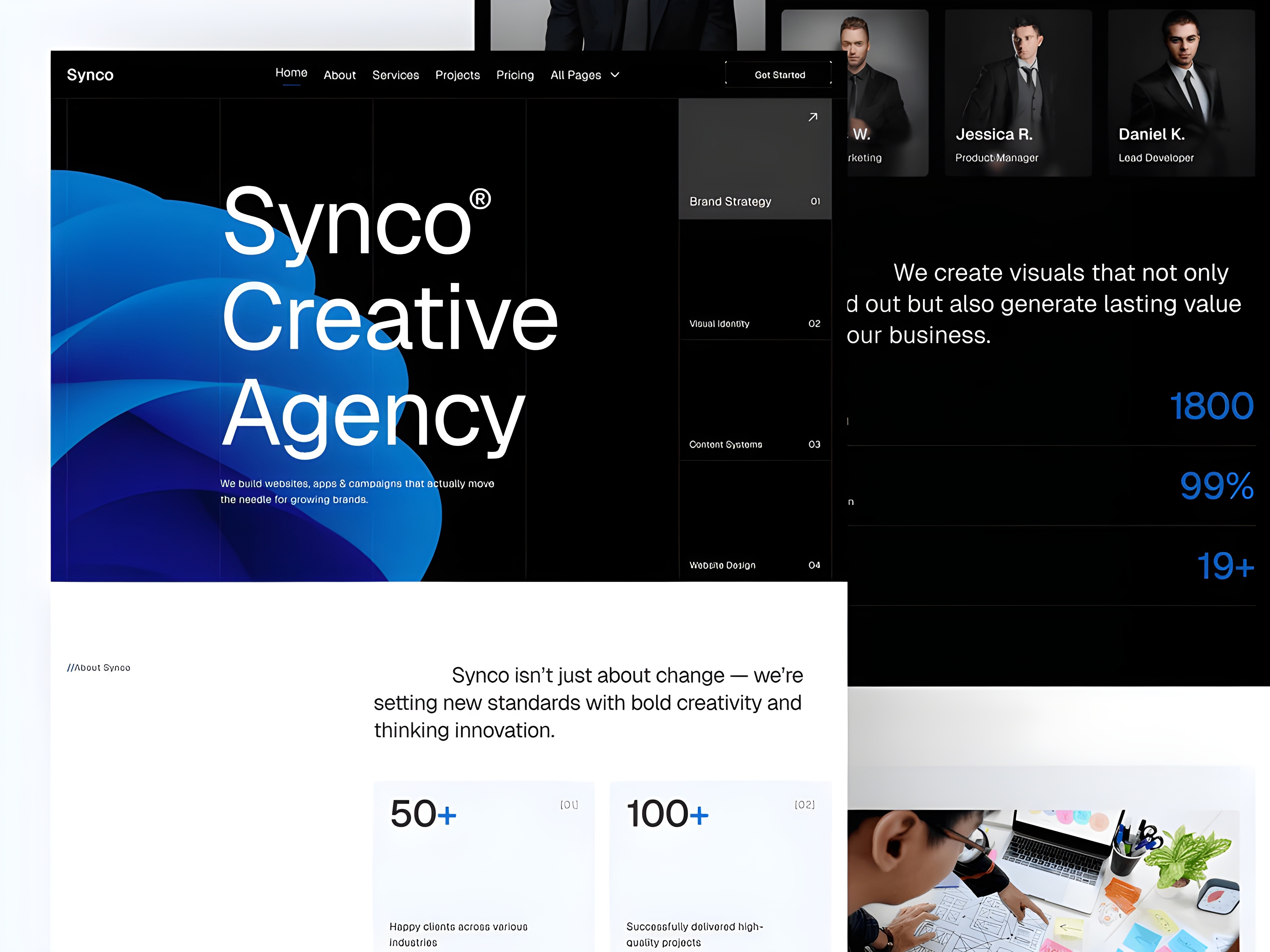
Synco is the most design-expressive agency template in the collection — built for creative studios, branding agencies, and design-focused teams where the quality of the website's own design is the primary proof point for the quality of the agency's work. Bold typography, smooth scroll animations, and distinctive layout rhythm communicate aesthetic sophistication immediately, before a visitor has engaged with a single piece of portfolio content.
Best for: Creative studios with a defined visual identity, branding and identity agencies, UX and product design studios, motion and animation firms.
Why it stands out: The website experience itself is the argument for hiring the team behind it — Synco makes that argument before a visitor reads a single case study.
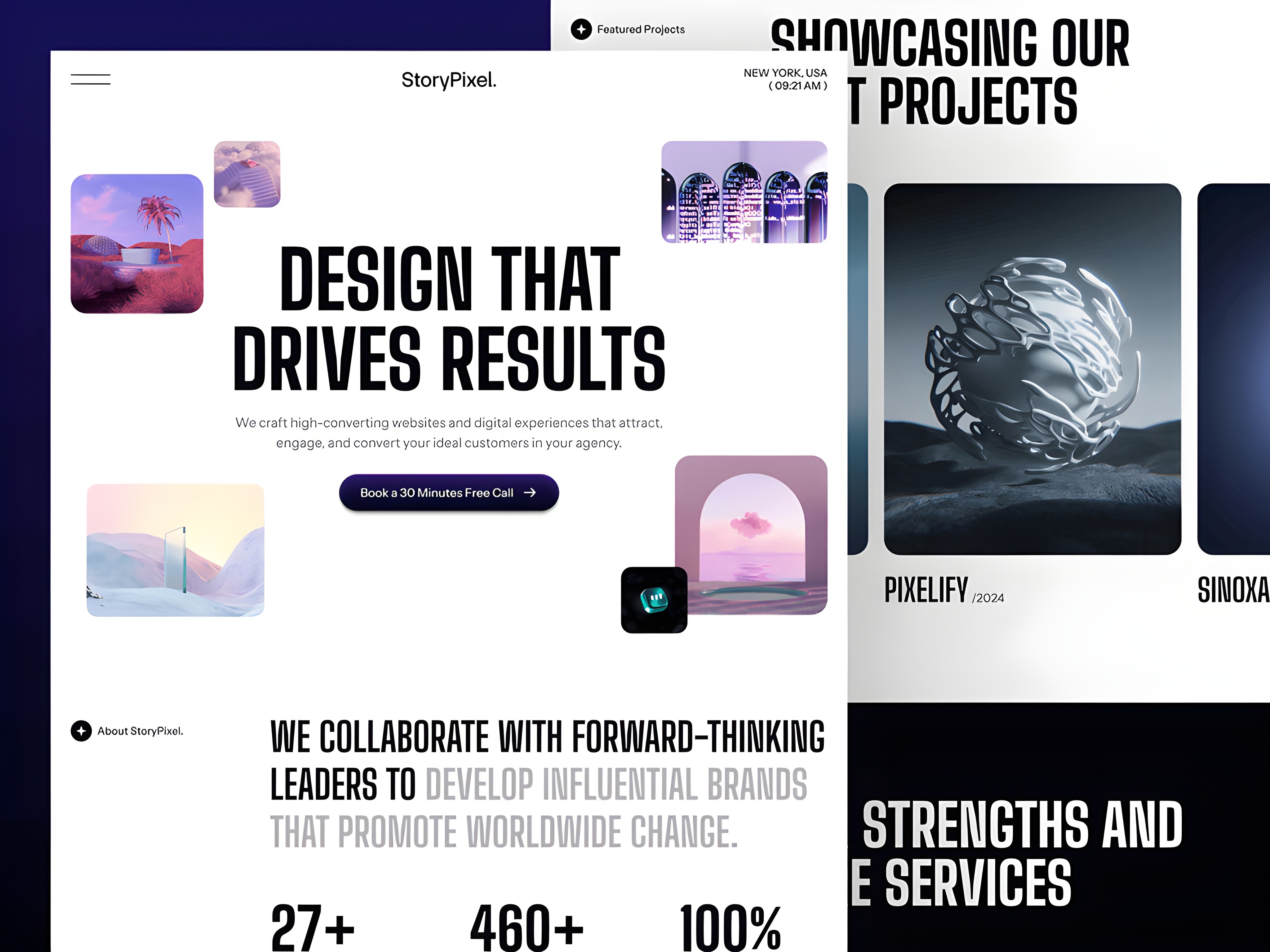
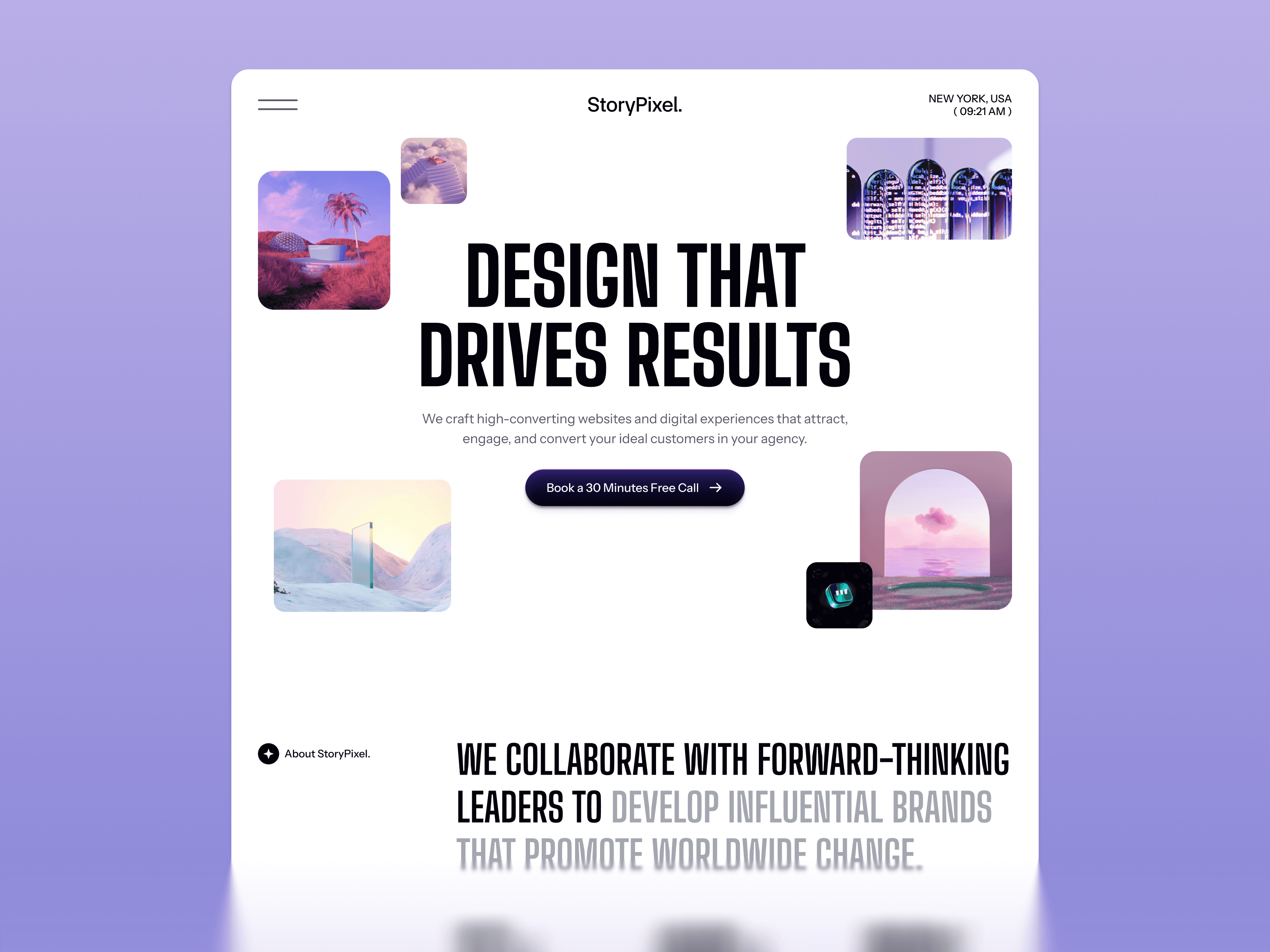
Storypixel is purpose-built for photography studios, film production companies, and visual storytelling agencies where the portfolio is presented at full impact — full-width imagery, editorial grid structure, minimal UI chrome — rather than constrained by template structure. The layout creates a visual environment where photography and video content feel like the natural center of the page.
Best for: Photography studios, film and video production agencies, visual content agencies, brand photography businesses.
Why it stands out: Most templates that claim to be built for photographers are general creative templates with a photo gallery added. Storypixel is built around how photography clients actually evaluate photographers.
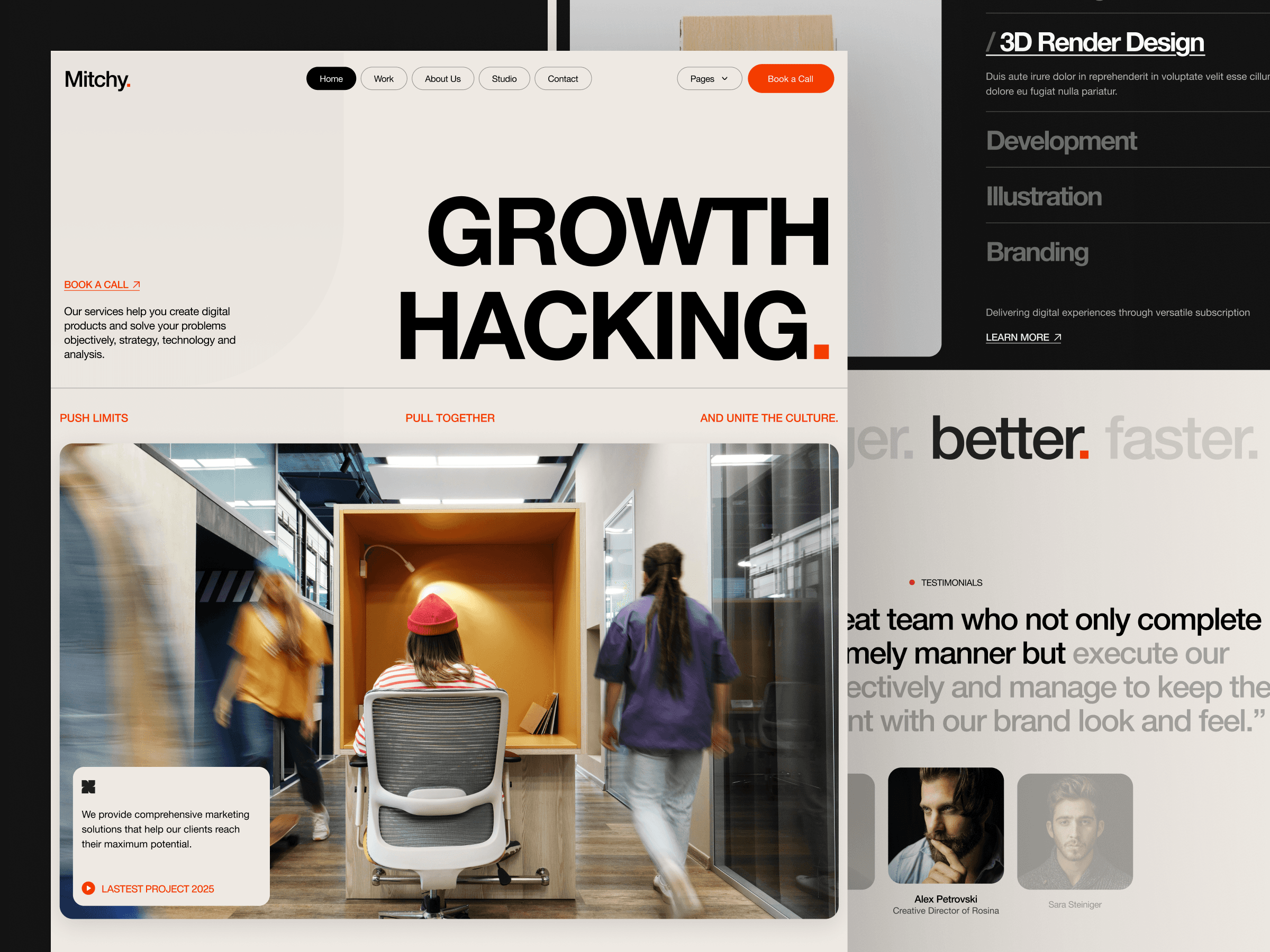
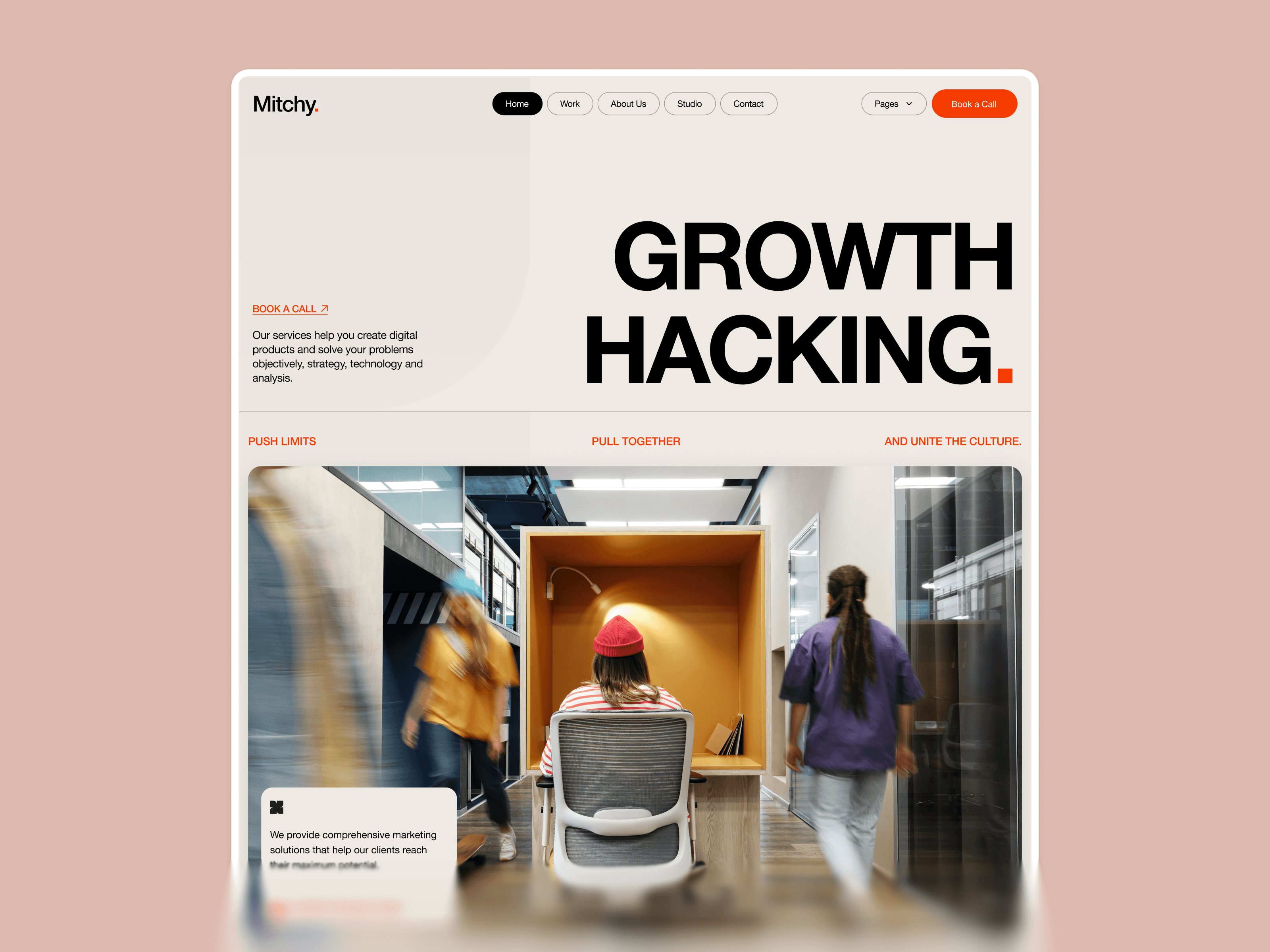
Mithcy is built for technology agencies, software development studios, and technical consultancies that need to communicate both deep technical capability and strong client service simultaneously. The dual-audience page architecture impresses technical evaluators while maintaining business outcome framing for the decision-makers who control the budget — the specific combination that most tech agency websites fail to achieve.
Best for: Software development agencies, technology consulting firms, web and app development studios, DevOps and cloud consultancies.
Why it stands out: Built for the tech agency whose website loses deals by impressing engineers but confusing the people who sign the contracts.
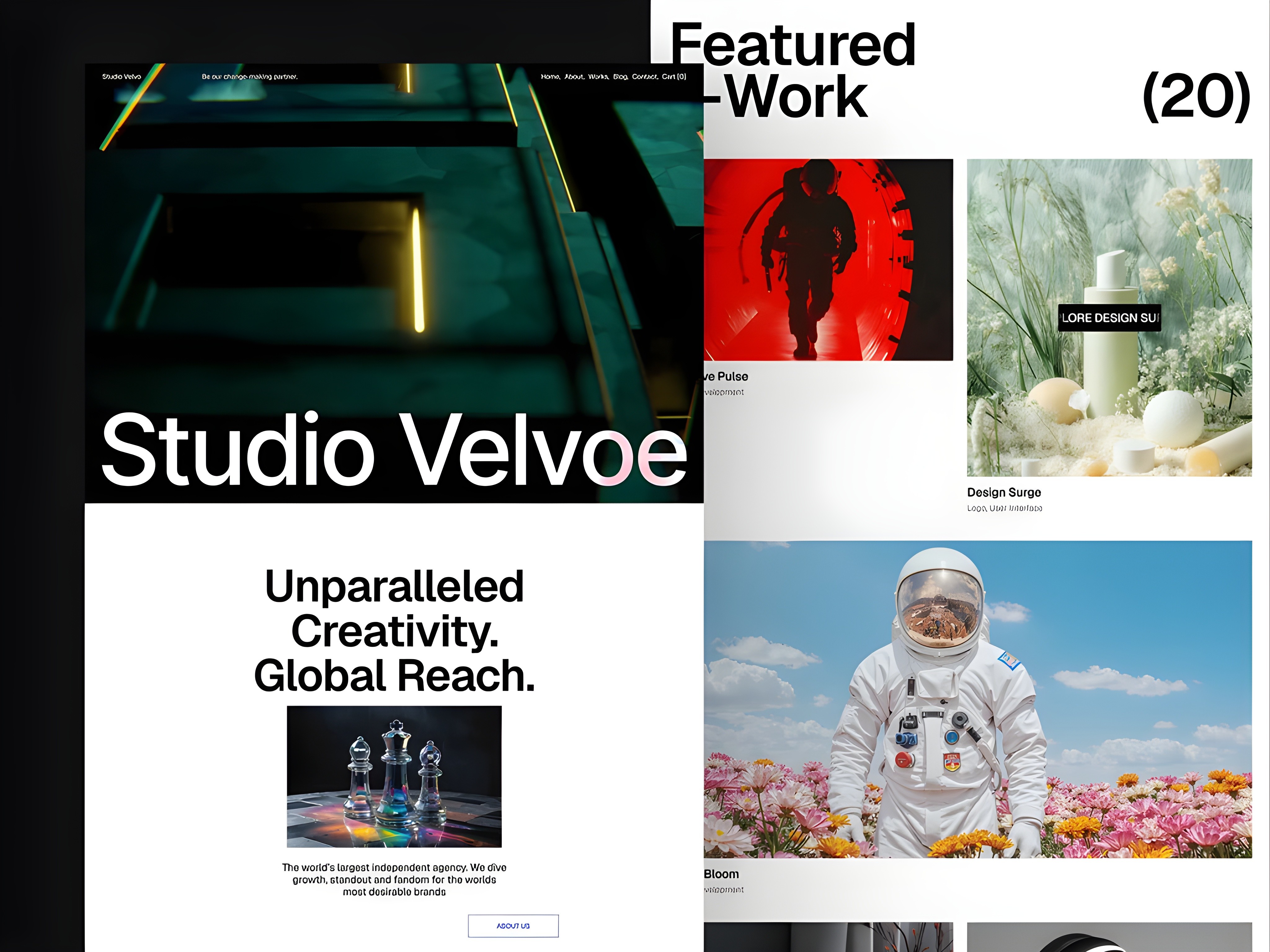
Studio Velvoe is the most premium-positioned template in the collection — built for luxury creative studios and high-end service businesses where the website's design quality sets price expectations before a potential client reads a single word of copy. Editorial typography, deliberate negative space, and refined layout decisions communicate exclusivity and taste at the level that luxury buyers use to evaluate agencies before making first contact.
Best for: Luxury creative studios, premium branding agencies, elite consulting firms, exclusive photography and film studios.
Why it stands out: The only template in this collection built specifically for the luxury creative market — where restraint and refinement are the design decisions that communicate premium value.
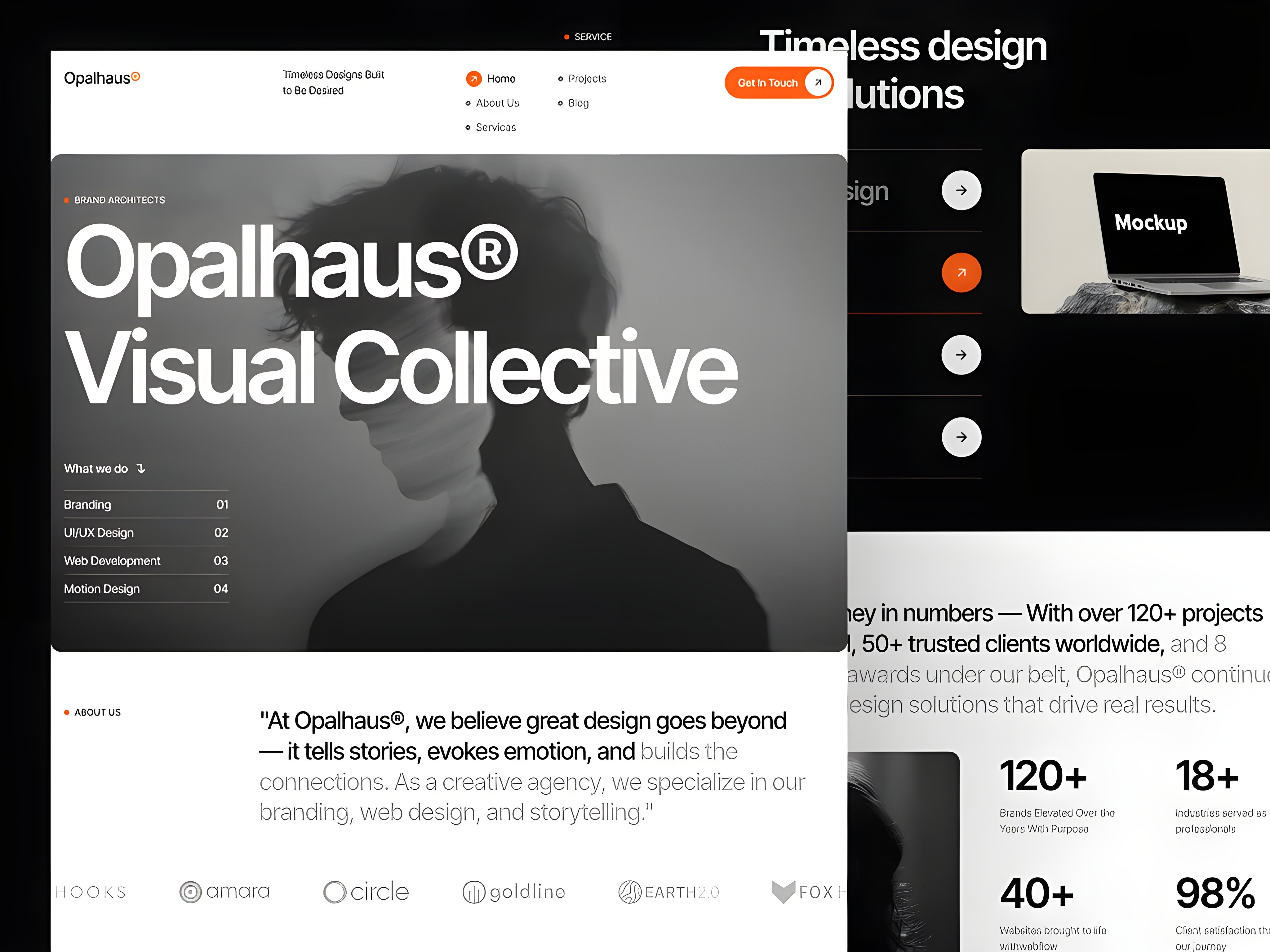
Opalhaus is purpose-built for interior design agencies, architecture studios, and spatial design consultancies where the portfolio needs to be presented at the scale and in the visual environment that does justice to the quality of physical space work. The warm dark design system and full-width photography sections create a presentation environment that makes interior photography feel exceptional rather than merely functional.
Best for: Interior design agencies, architecture studios, spatial design consultancies, luxury residential and commercial design firms.
Why it stands out: Interior design and architecture agencies lose clients because their websites look generic when their actual work is exceptional. Opalhaus solves that mismatch.
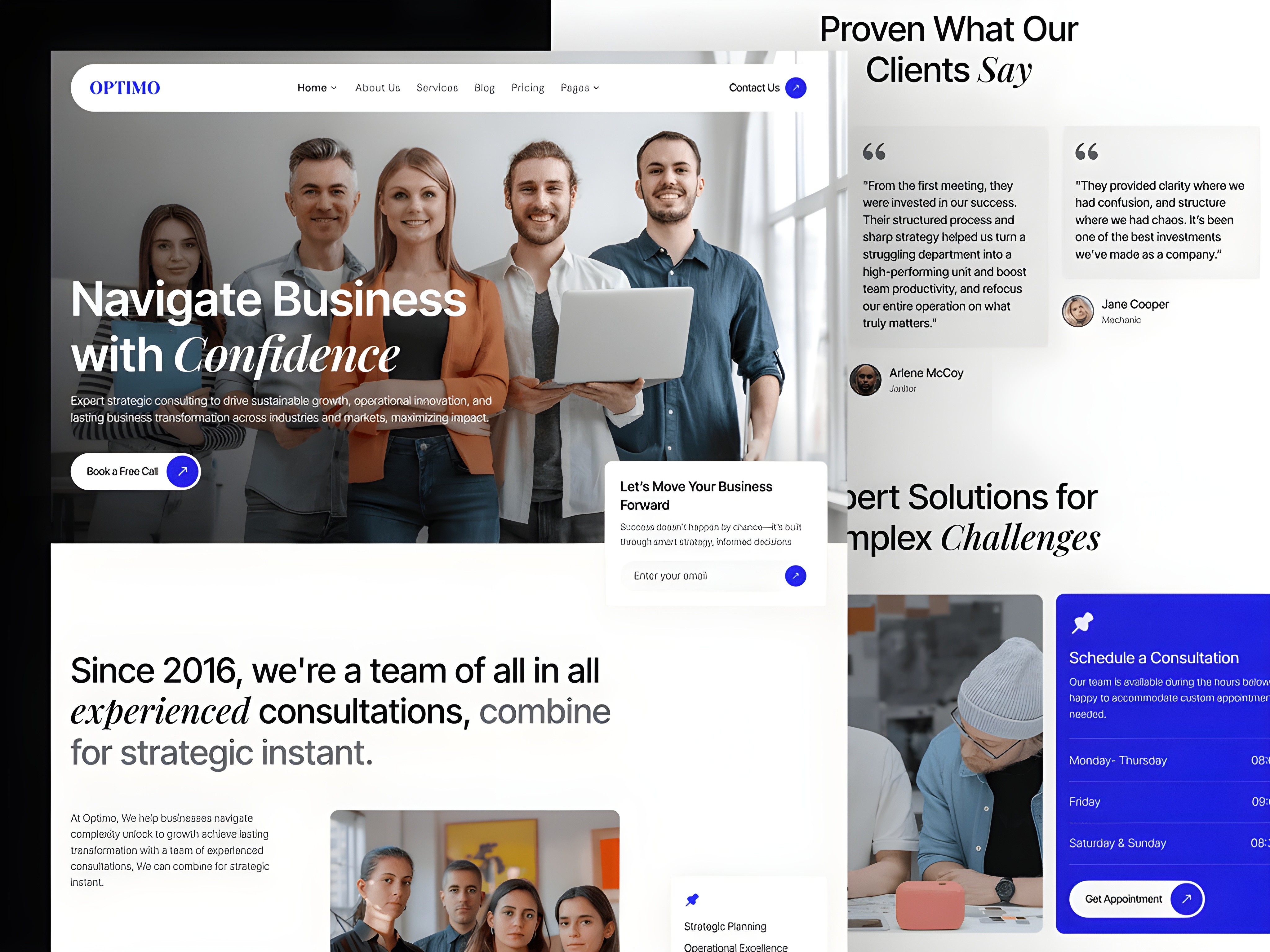
Optimo is built for growth agencies and digital marketing firms that sell with data rather than aesthetics. The results showcase section and outcome-framed case study layouts give you the structural framework to present your agency's track record in the business outcome terms that clients actually care about — not the activity metrics that agencies often mistake for proof.
Best for: Growth hacking agencies, digital marketing studios, SEO and content agencies, social media and paid media firms.
Why it stands out: Purpose-built for the data-led sales conversation that growth agency clients expect — structured around results, not service descriptions.
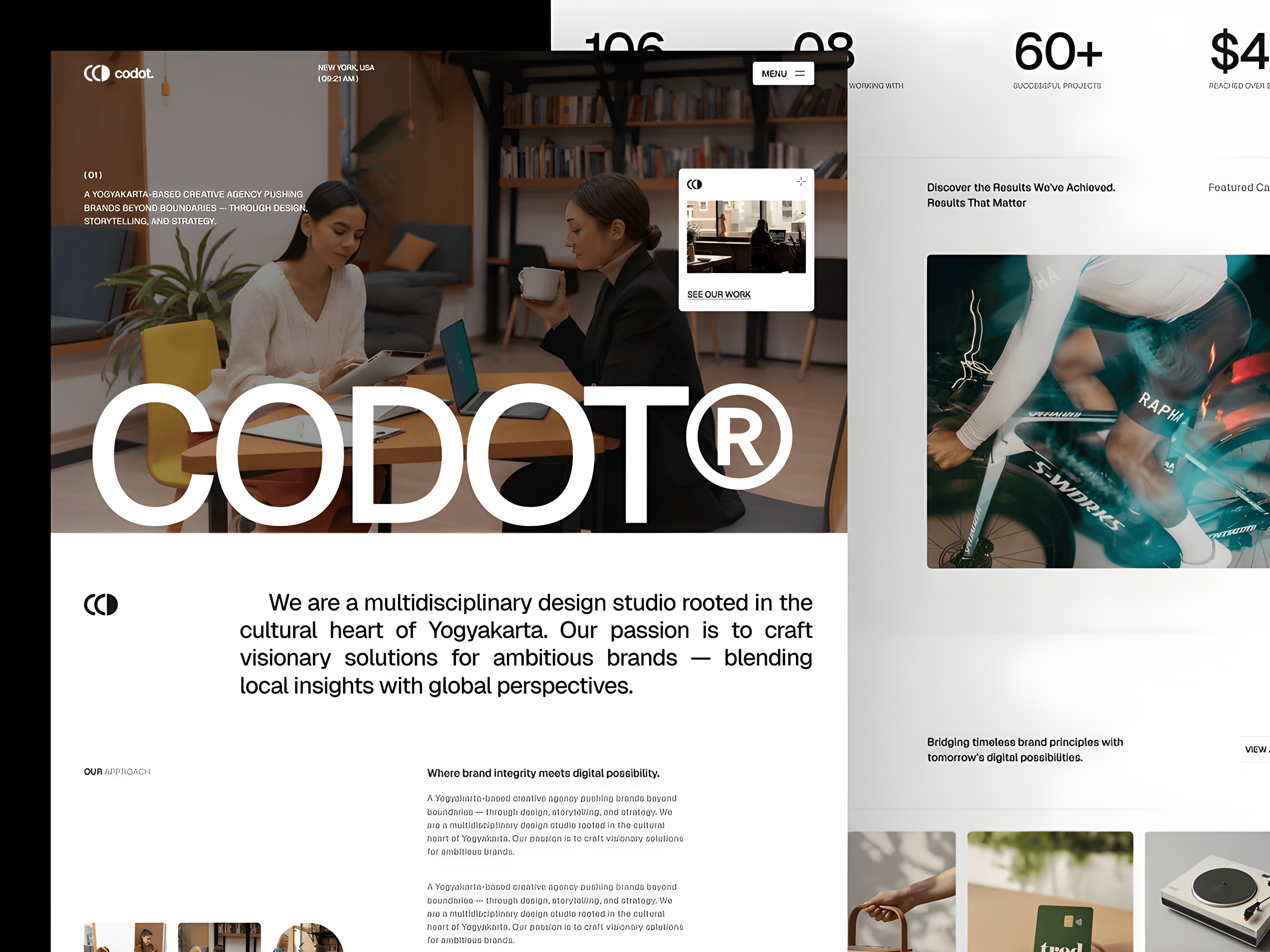
Codot is the strongest free agency template in the Pentaclay library — built for developer studios, technical agencies, and code-focused creative businesses that want a professional web presence without an upfront template investment. The clean, developer-adjacent design system communicates technical competence without requiring the visual sophistication that a design-focused agency would need.
Best for: Developer studios, freelance developers positioning as an agency, technical consultancies, web development agencies at the startup stage.
Why it stands out: Free, professionally designed, and built with the developer-appropriate visual language that technical agency clients recognize and trust immediately.
Framer AI Templates
AI products have a higher communication burden than almost any other type of software. Your visitor arrives skeptical, unfamiliar with your approach, and deciding within seconds whether your product is worth their attention. The best Framer AI templates are purpose-built for that challenge — with problem-led hero sections, structured capability breakdowns, and trust signal placement at the exact moments where AI buyer skepticism peaks.
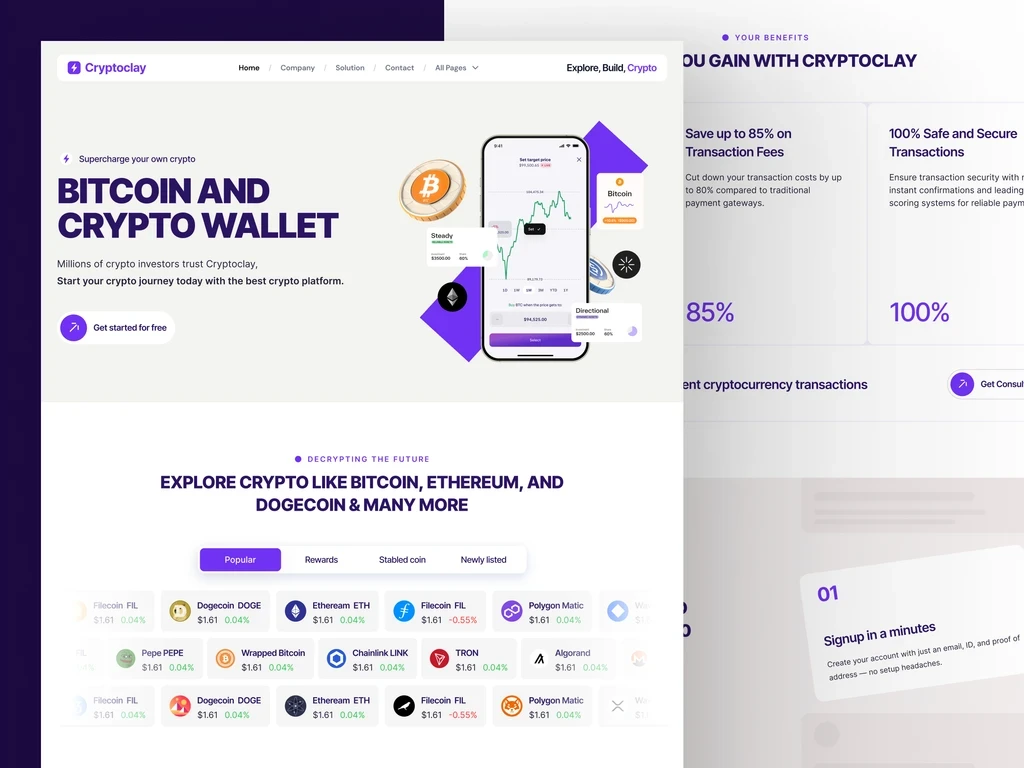
Cryptoclay is purpose-built for the intersection of AI and blockchain — crypto platforms, Web3 AI tools, and decentralized AI protocols. The high-impact dark design system with bold accent tones reflects the aesthetic expectations of the crypto-native market, where visual sophistication is itself a signal of product legitimacy. The hero combines innovation and security credibility in a single visual moment — the hardest thing to achieve in Web3 product design.
Best for: AI-powered crypto platforms, Web3 startup sites, DeFi tools with an AI layer, blockchain-based AI products.
Why it stands out: The only template in the collection built specifically for the trust and visual language demands of the crypto-AI market.
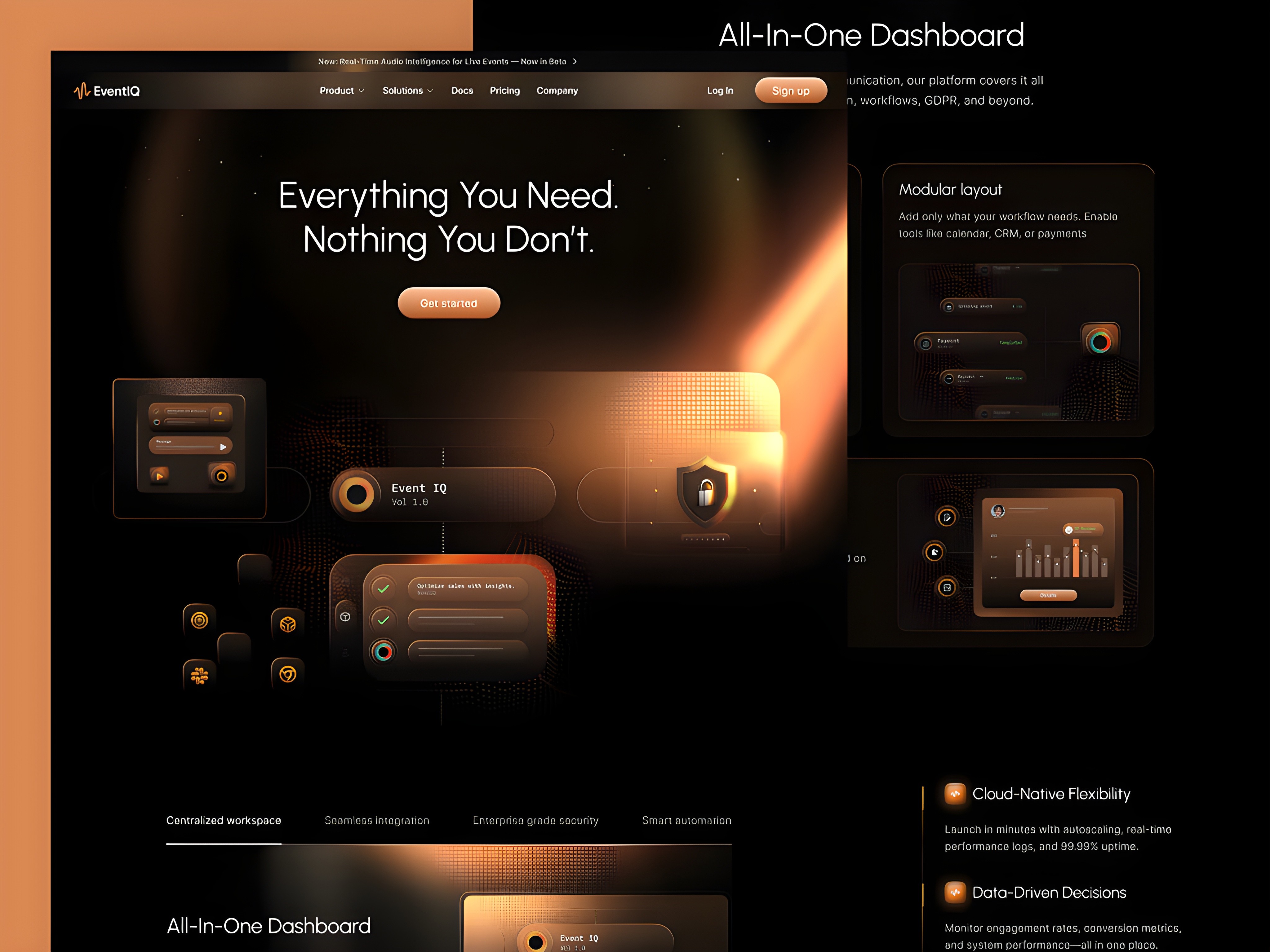
EventIQ is the most structurally flexible AI template in the collection — a multipurpose layout built for AI platforms serving multiple audience segments or product categories. The modular feature sections, integration logo grid, and adaptable hero structure make it the right starting point for AI founders who need structural flexibility as their product and positioning evolve.
Best for: Multipurpose AI platforms, AI tools serving multiple verticals, SaaS products with an AI feature layer, early-stage teams testing positioning.
Why it stands out: Most AI templates are built for one specific product type. EventIQ is built for breadth — the right choice when your product or positioning is still evolving.

Chatpilot is purpose-built for AI chat products, chatbot platforms, and AI agent builders — the only template in the AI collection specifically designed around a dialogue-driven product experience. The dark terminal-style design system is immediately recognizable as developer-adjacent, and the chat UI showcase in the hero makes the abstract product experience concrete before a visitor has to request a demo.
Best for: AI chatbot startups, conversational AI platforms, AI agent builders, customer support automation tools.
Why it stands out: The chat UI in the hero and the step-by-step explanation section solve the hardest challenge in selling conversational AI — demonstrating the product experience before signup.
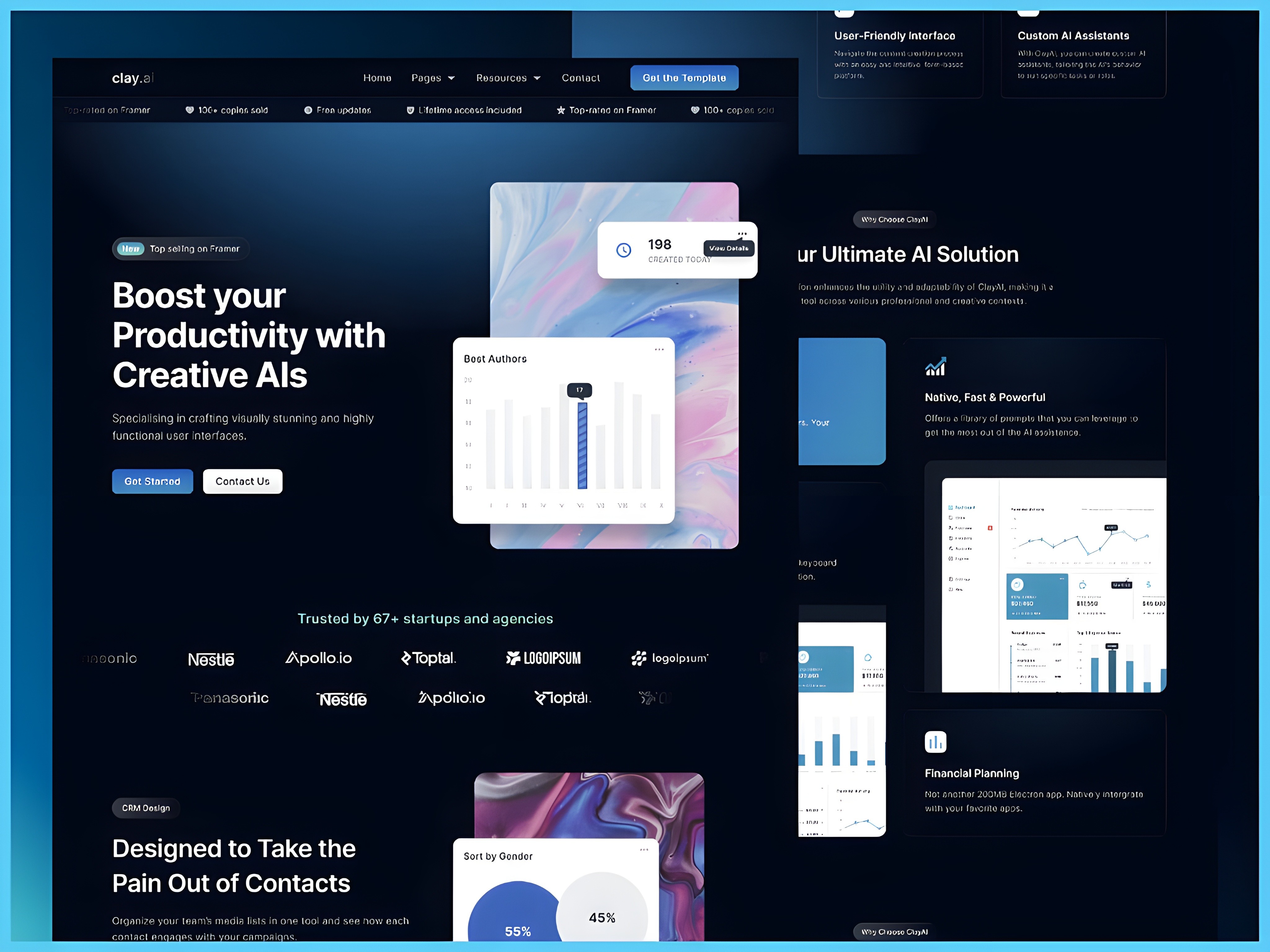
ClayAI is the most conversion-engineered template in the AI collection — built for complex AI SaaS platforms that need to explain a multi-feature product to a non-technical buyer without losing them in the first scroll. The product UI mockup hero, early social proof placement, and multi-section feature breakdown address the three questions every AI visitor asks within the first scroll: what does this do, who else uses it, and how does it work.
Best for: AI SaaS platforms, multi-feature productivity tools, AI startups targeting agencies and growing teams.
Why it stands out: The strongest cold-visitor conversion template in the AI collection — built specifically for complex products selling to buyers who encounter them for the first time.
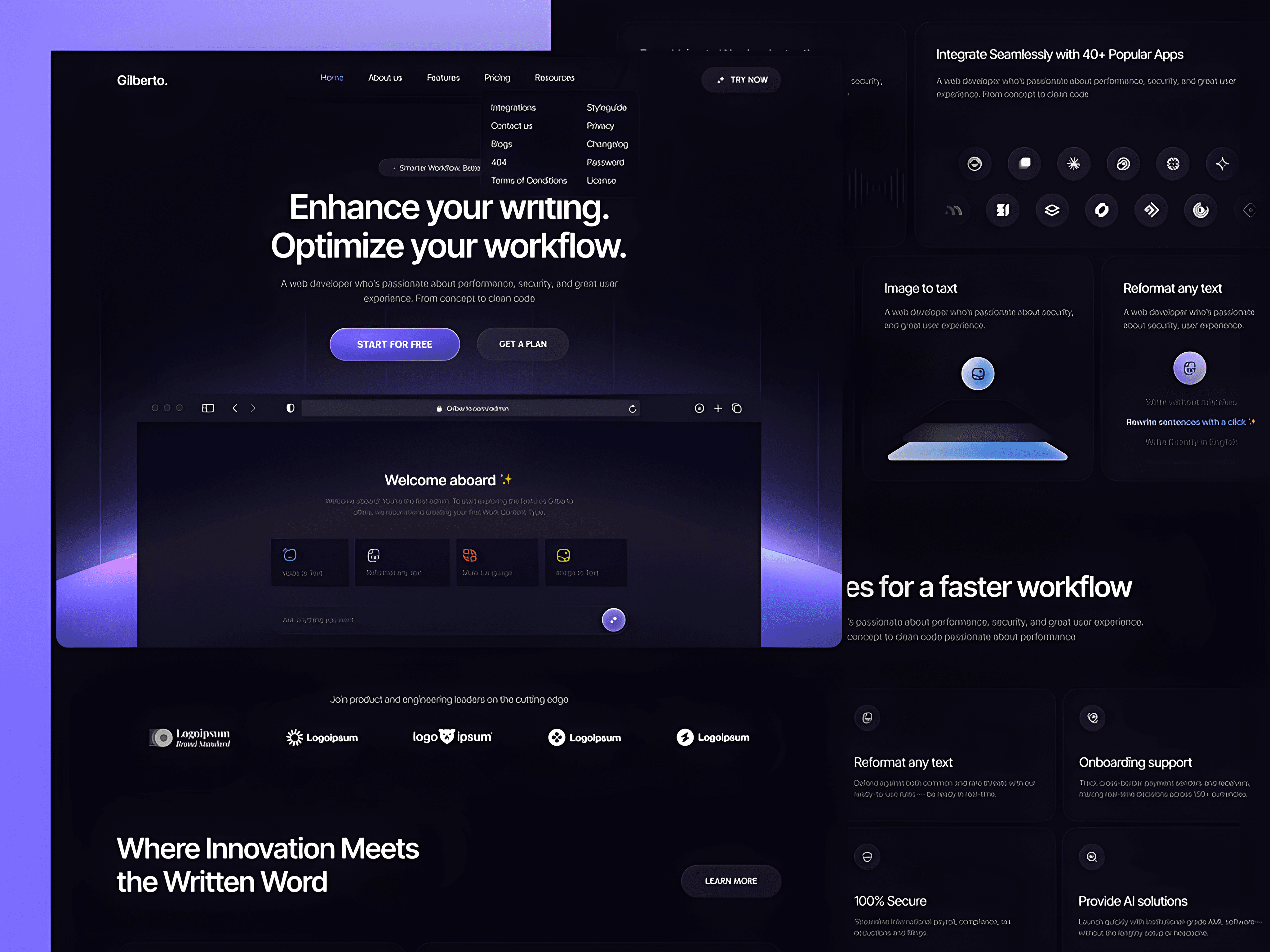
Gilberto is the most design-forward template in the AI collection — a deep purple-toned dark layout built for AI writing tools, content platforms, and productivity software where visual sophistication is itself a trust signal. The multi-panel product UI showcase section shows the product working across multiple contexts simultaneously, communicating feature depth to a visitor who has not yet had a demo.
Best for: AI writing and content tools, AI productivity platforms, workflow automation software with a strong visual brand.
Why it stands out: Genuinely distinctive visual identity rather than just a dark background with neon accents — the right choice when your website's design quality signals your product's quality.
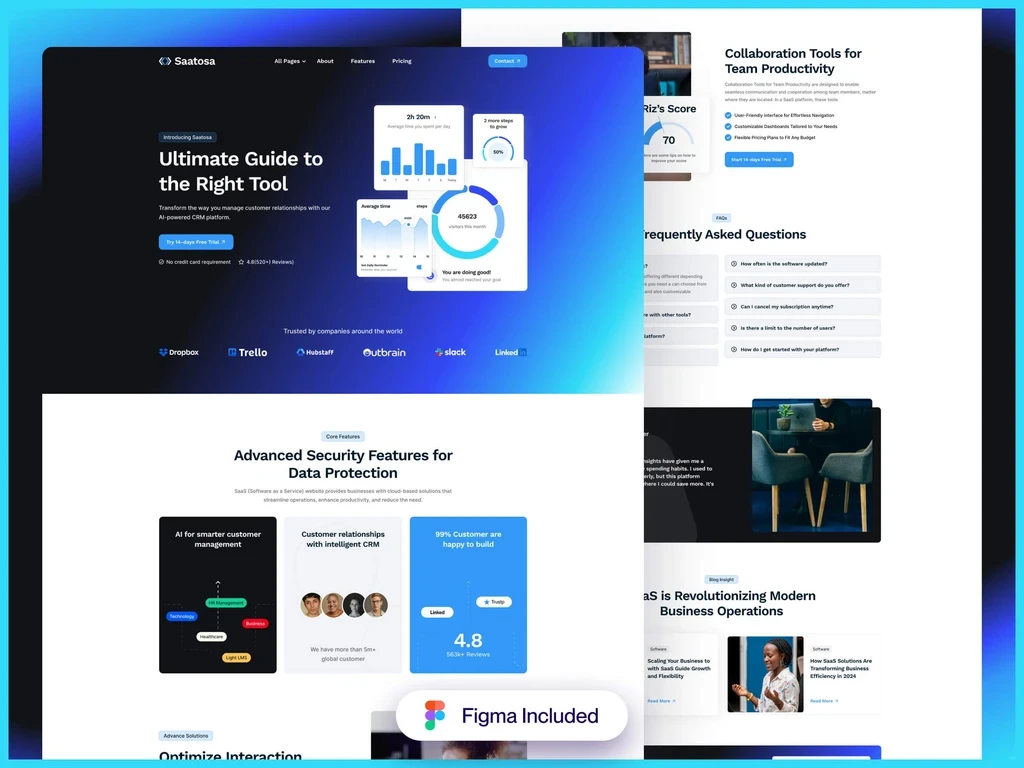
Saatosa is purpose-built for fintech AI tools, financial automation platforms, and AI-powered analytics products — the category where trust and credibility requirements are highest. The dashboard UI elements and data visualization components immediately communicate financial product depth, while the security and compliance signal placement addresses the specific trust barrier that financial AI buyers face before connecting a platform to their data.
Best for: Fintech AI startups, financial SaaS products, AI-powered investment or analytics tools, financial automation platforms.
Why it stands out: Designed specifically to clear the trust barrier that financial AI products face — not just look credible but structurally earn trust before the first CTA.
Framer Startup Templates
Startups do not get a second chance at a first impression. Your website needs to look established before you are, communicate your value proposition clearly before your product is fully built, and convert visitors into signups or waitlist joins without requiring a polished sales deck. The best Framer startup templates are built for exactly that operating mode.
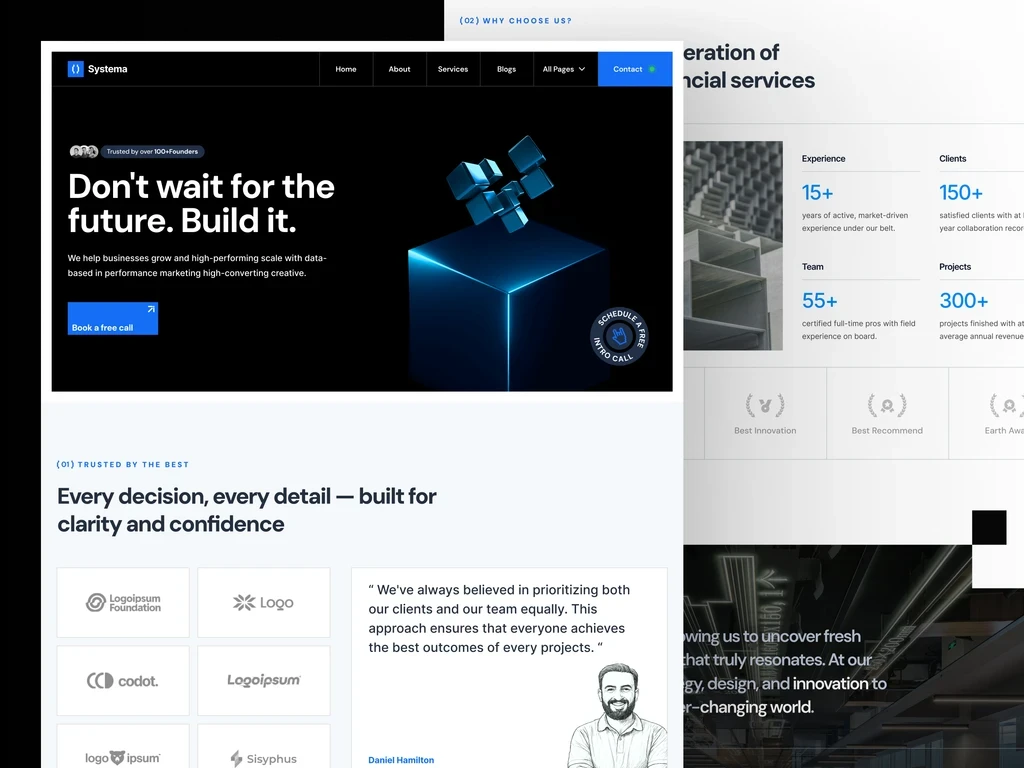
Systema is built for SaaS startups and business platforms targeting mid-market or enterprise buyers who evaluate software on reliability and structural clarity before aesthetics. The page architecture is engineered around the B2B buyer journey — problem statement, capability proof, credibility signals, demo request CTA — with every section serving a defined purpose in the conversion sequence.
Best for: B2B SaaS startups, business productivity platforms, project management tools, enterprise-adjacent software products.
Why it stands out: The most business-appropriate template in the startup collection — communicates that your product is built for serious use by serious teams.
For crypto and Web3 startups, Cryptoclay combines innovation and security credibility in a visual language that crypto-native buyers immediately recognize and evaluate. The dark design system, roadmap sections, and token presentation layouts are built for the specific trust architecture that blockchain startup buyers apply when evaluating new platforms.
Best for: Crypto startup founders, Web3 platform builders, DeFi product teams, NFT and blockchain startups.
Why it stands out: Using a generic SaaS template for a Web3 product communicates that you do not understand your own market. Cryptoclay communicates immediately that you do.
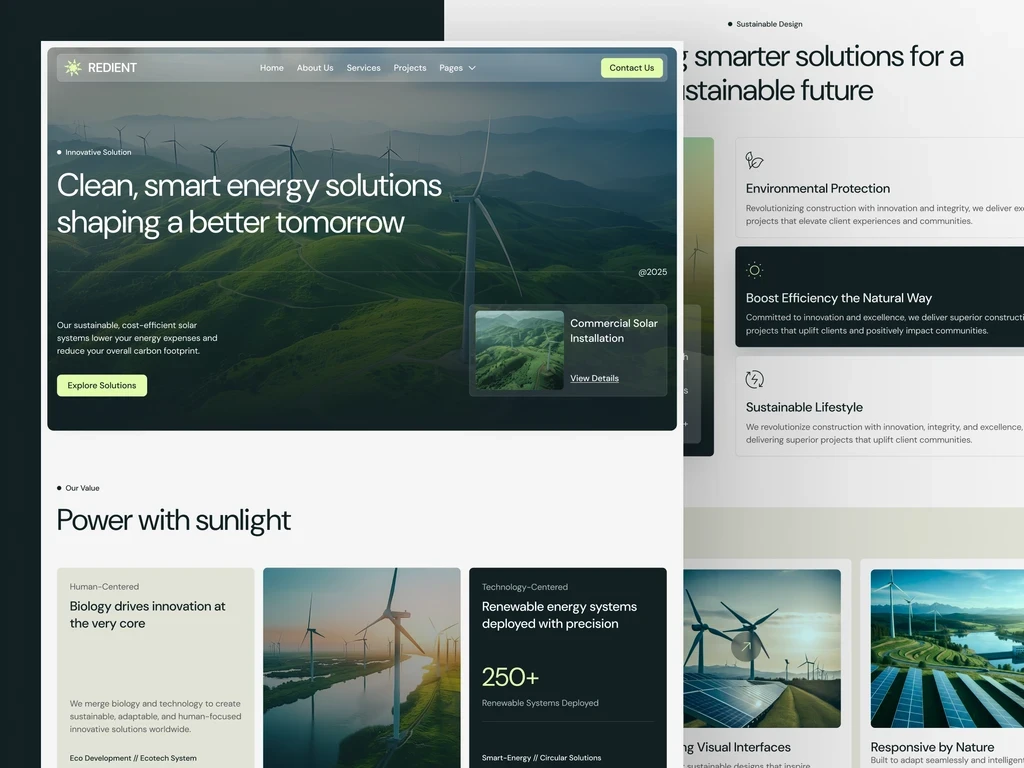
Redient is the most visually distinctive startup template in the collection — built for creative tools, design platforms, and any early-stage product where the aesthetic quality of the website is part of the value proposition. The bold editorial design system and brand statement hero communicate design thinking at every level before a visitor reads a single feature description.
Best for: Creative tool startups, design platform founders, marketing technology with a strong visual identity.
Why it stands out: For creative product founders, the quality of your website's design is the first proof point that your product delivers what it promises.
For startups serving multiple audiences, testing positioning, or building products that do not fit neatly into a single category, EventIQ's modular structure and adaptable hero provide the structural flexibility needed without a rebuild every time messaging evolves.
Best for: Multipurpose SaaS startups, AI-powered platforms serving multiple verticals, startup studios building multiple products.
Why it stands out: Built for breadth rather than a specific product type — the right choice when your startup does not fit neatly into one category.
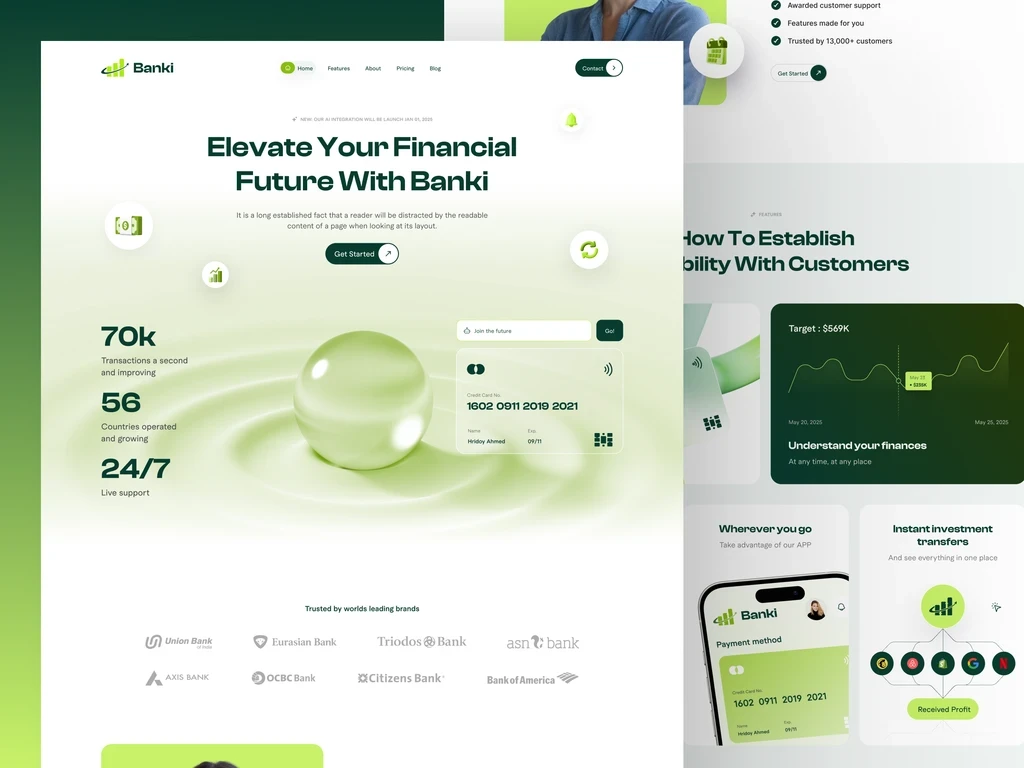
Banki addresses the specific trust problem of every fintech startup — establishing enough credibility with a cold visitor to get them past the skepticism stage and into genuine product evaluation. The dashboard UI elements and financial data visualization communicate product depth and data credibility before a visitor reads a single feature description.
Best for: Fintech startup founders, banking and payments platform builders, financial automation SaaS products, investment and wealth management tools.
Why it stands out: The dashboard UI and security signal placement are designed specifically for buyers evaluating whether to trust you with their financial data.
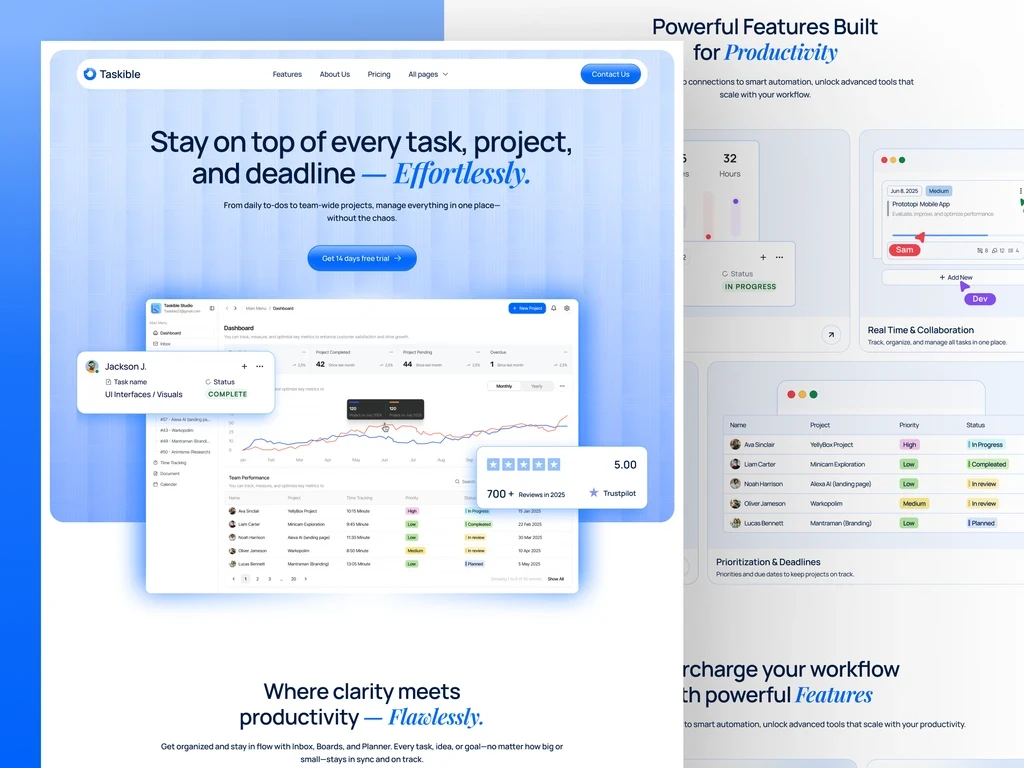
Taskible is structured around the specific conversion challenge of productivity SaaS — not explaining the product category but convincing a visitor who already uses three other productivity tools that yours is worth switching to. The clean, organized design system reflects the same organizational clarity the product itself promises to deliver, which is the most important trust signal in the productivity category.
Best for: Task management SaaS startups, productivity tool founders, project management platforms, team workflow tools.
Why it stands out: The page architecture is specifically built to answer the switching question — why change from what I already use — which is the primary conversion barrier for any productivity tool.
For AI and SaaS startups that want their website to communicate the same level of sophistication as their product, Gilberto's deep dark design system, multi-panel UI showcase, and platform stats section give early-stage founders an enterprise-grade aesthetic and a structural framework for presenting traction at whatever scale is accurate for their product.
Best for: AI writing and productivity startups, workflow automation SaaS, content intelligence platforms, AI-native startups with strong visual brand identity.
Why it stands out: The multi-panel UI showcase communicates feature depth to a visitor who has not yet had a demo — the most valuable structural element for early-stage SaaS.
For conversational AI startup founders, Chatpilot is the most purpose-specific template in the collection. The chat UI in the hero, the operational metrics section, and the step-by-step explanation together give a first-time visitor three separate forms of product proof before they have scrolled halfway down the page — solving the concrete-demonstration problem that every conversational AI startup faces.
Best for: AI chatbot startup founders, conversational AI platform builders, AI agent product teams, customer support automation startups.
Why it stands out: Every structural decision is made specifically for dialogue-driven product experiences and the evaluation process of conversational AI buyers.
Framer SaaS Templates
SaaS websites are part of the product experience — not just a marketing front. The moment a visitor lands, they are beginning to evaluate your product's quality, reliability, and fit. The best Framer SaaS templates are engineered around how SaaS buyers actually make purchasing decisions, not around what looks impressive in a Dribbble screenshot.
For SaaS products serving multiple buyer segments or with positioning still evolving, EventIQ's modular structure and adaptable content sections provide the structural flexibility to present different capabilities to different audiences without requiring a page rebuild every time your messaging changes.
Best for: B2B SaaS platforms, AI-powered business tools, productivity and workflow software, multi-segment SaaS products.
Why it stands out: The most versatile SaaS template in the collection — built for founders who prioritize structural flexibility over a predetermined visual identity.
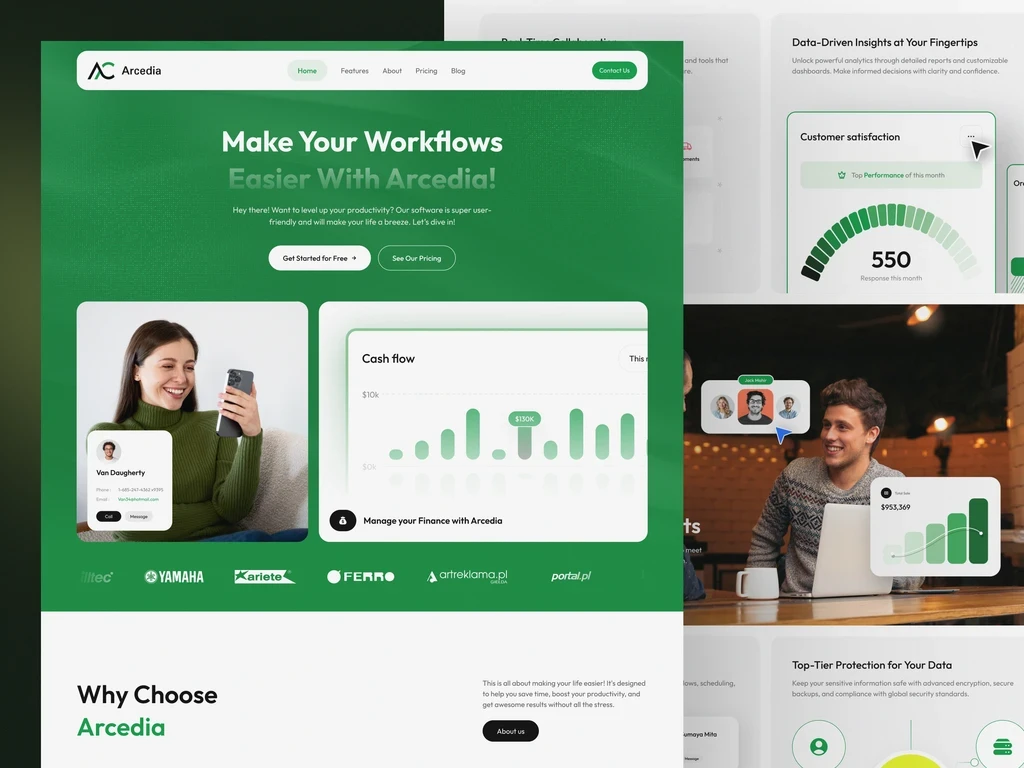
Arcedia is purpose-built for the enterprise B2B sales motion — getting a risk-averse business buyer past skepticism and into a genuine product evaluation conversation. The demo-request CTA structure, enterprise social proof placement, and structured capability breakdown all reflect how B2B software is actually evaluated and purchased when multiple stakeholders are involved in the buying decision.
Best for: B2B SaaS platform founders, enterprise software product teams, API-first products, developer tools with enterprise sales motion.
Why it stands out: The most strategically appropriate template for SaaS teams selling upmarket where demo requests rather than self-serve trials drive revenue.
For AI writing, productivity, and workflow SaaS products, Gilberto's distinctive dark design system and multi-panel UI showcase communicate the visual sophistication and feature depth that this specific buyer category expects. The platform stats section gives early-stage SaaS founders a structural framework for communicating traction at whatever scale is accurate for their product.
Best for: AI productivity SaaS, workflow automation platforms, content intelligence tools, developer-adjacent SaaS with a technical buyer.
Why it stands out: Shows the product working across multiple contexts simultaneously — the most effective structural element for SaaS products where a demo is the normal conversion path.
For conversational AI and chatbot SaaS products, Chatpilot makes the abstract product experience concrete before a visitor has to request a demo. The terminal-style design, chat UI hero, operational metrics, and step-by-step explanation section are all purpose-built for dialogue-driven SaaS products and the technical buyers who evaluate them.
Best for: AI chatbot SaaS, conversational AI platforms, AI agent builders, customer support automation software.
Why it stands out: The only SaaS template in the collection built specifically for dialogue-driven product experiences and the evaluation process of conversational AI buyers.
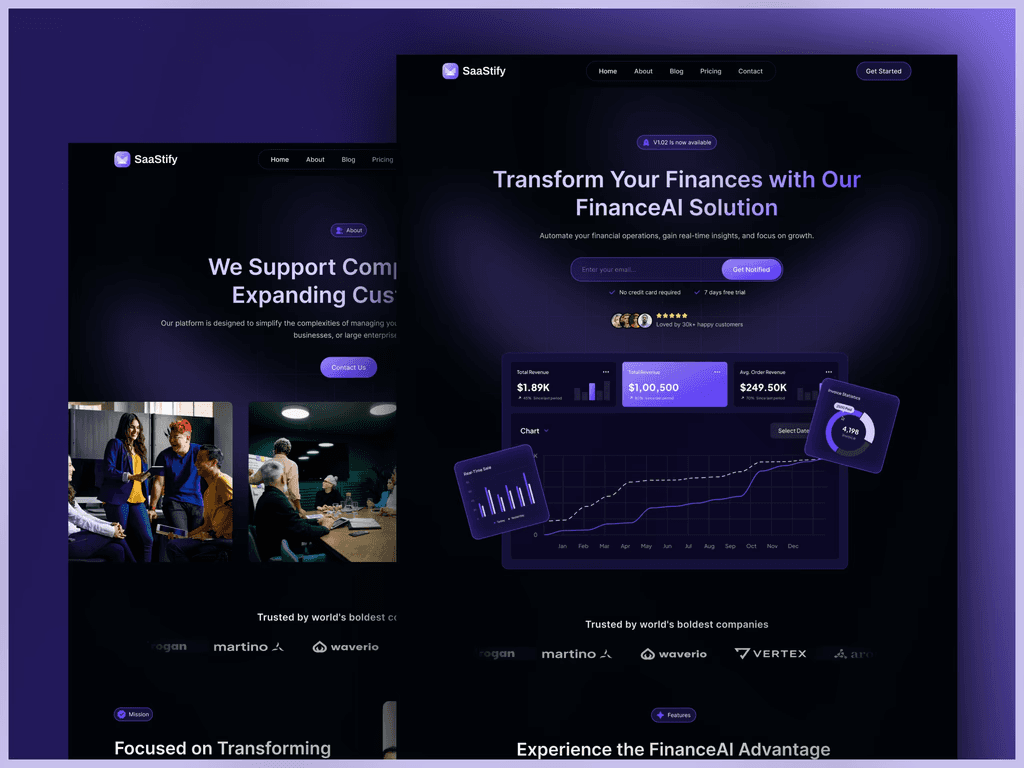
Saatify is the most accessible entry point in the SaaS collection at $49 — a fintech-focused design with dashboard UI elements and data visualization components that give it an immediate sense of financial product depth. The transformation-led hero and transparent pricing structure address the specific trust and credibility signals that financial SaaS buyers evaluate before connecting a platform to their data.
Best for: Fintech SaaS startups, financial analytics platforms, accounting and expense management software, AI-powered investment tools.
Why it stands out: The rare $49 template that does not look like a $49 template — dashboard UI components communicate financial product depth at the most accessible price in the collection.
ClayAI addresses the most common SaaS conversion failure — a cold visitor who encounters a complex product, does not understand it within the first scroll, and bounces. The product UI mockup hero, early social proof, and multi-section feature breakdown work together to answer the three questions every SaaS visitor asks before converting: what does this do, who else uses it, and how does it work.
Best for: AI SaaS platforms, multi-feature productivity tools, SaaS products targeting agencies and growing businesses as primary buyers.
Why it stands out: The strongest cold-visitor conversion template in the SaaS collection — built for complex products where the website has to do the full explanation job before a trial starts.
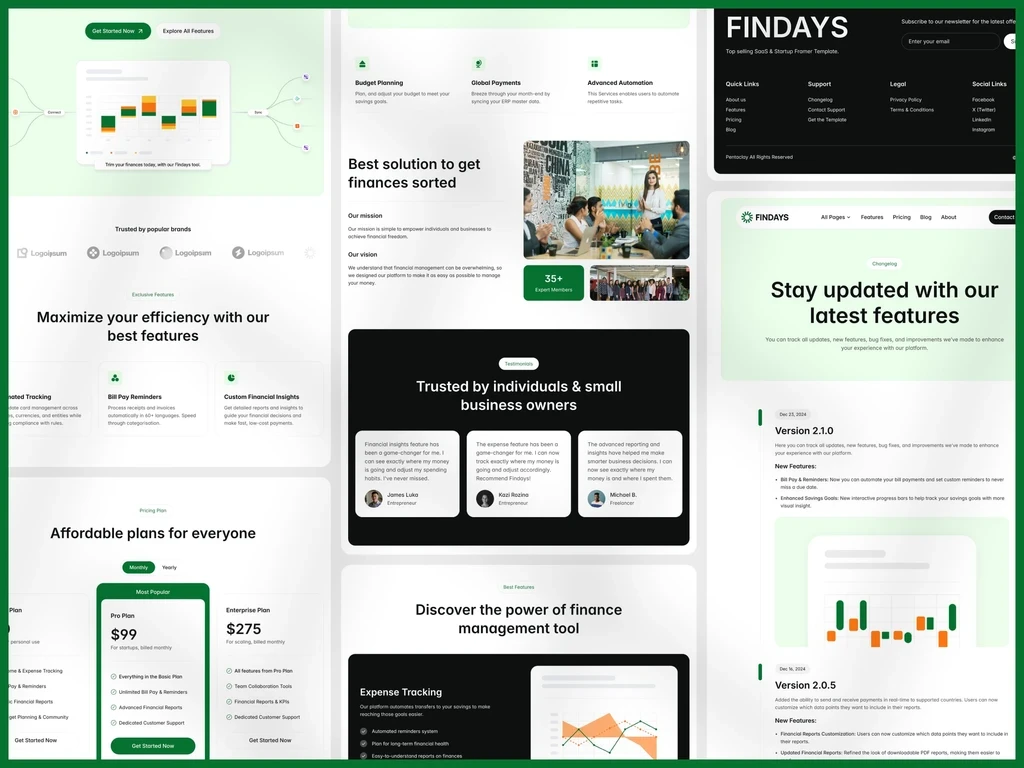
Findays is structured around the differentiation and switching-cost challenges specific to financial management SaaS — a crowded category where most competitors offer similar features and where the primary conversion barrier is convincing a visitor who already uses another tool that switching is worth the friction. The clean data-forward design communicates the product's core promise of financial clarity before a visitor reads a single feature description.
Best for: Personal finance management SaaS, business expense tracking tools, budgeting and financial planning software, financial reporting platforms.
Why it stands out: Built specifically for the switching conversation — answering the "why change from what I already use" objection that is the primary barrier in every financial management SaaS category.
Framer Portfolio Templates
A portfolio website is your most powerful sales tool — and how it presents your work in the first three seconds determines whether a potential client scrolls or leaves. The best Framer portfolio templates put your work front and center with case study depth, personal brand expression, and inquiry flows that convert viewers into clients.
As a portfolio template, Rendani carries both individual creative identity and organizational credibility simultaneously — the combination that converts enterprise clients rather than just impressing them. The case study layouts, project counters, and client testimonials are all positioned to address the skepticism that high-budget clients bring to evaluating a new creative relationship.
Best for: Creative agency portfolios, marketing studio websites, senior designers building studio-level positioning.
Why it stands out: The only portfolio template built to communicate both individual talent and studio organizational depth in the same page structure.
As a portfolio template, Mitaly's editorial design system and philosophy sections give design studios the structural environment to express a genuine creative point of view — not just list services. The dark, bold typographic identity positions your studio as having a perspective that extends beyond the work itself.
Best for: Design studio portfolios, branding agency websites, creative practices with a distinctive aesthetic philosophy.
Why it stands out: Built for studios with a genuine point of view who want a website that expresses it with the same confidence as their best work.
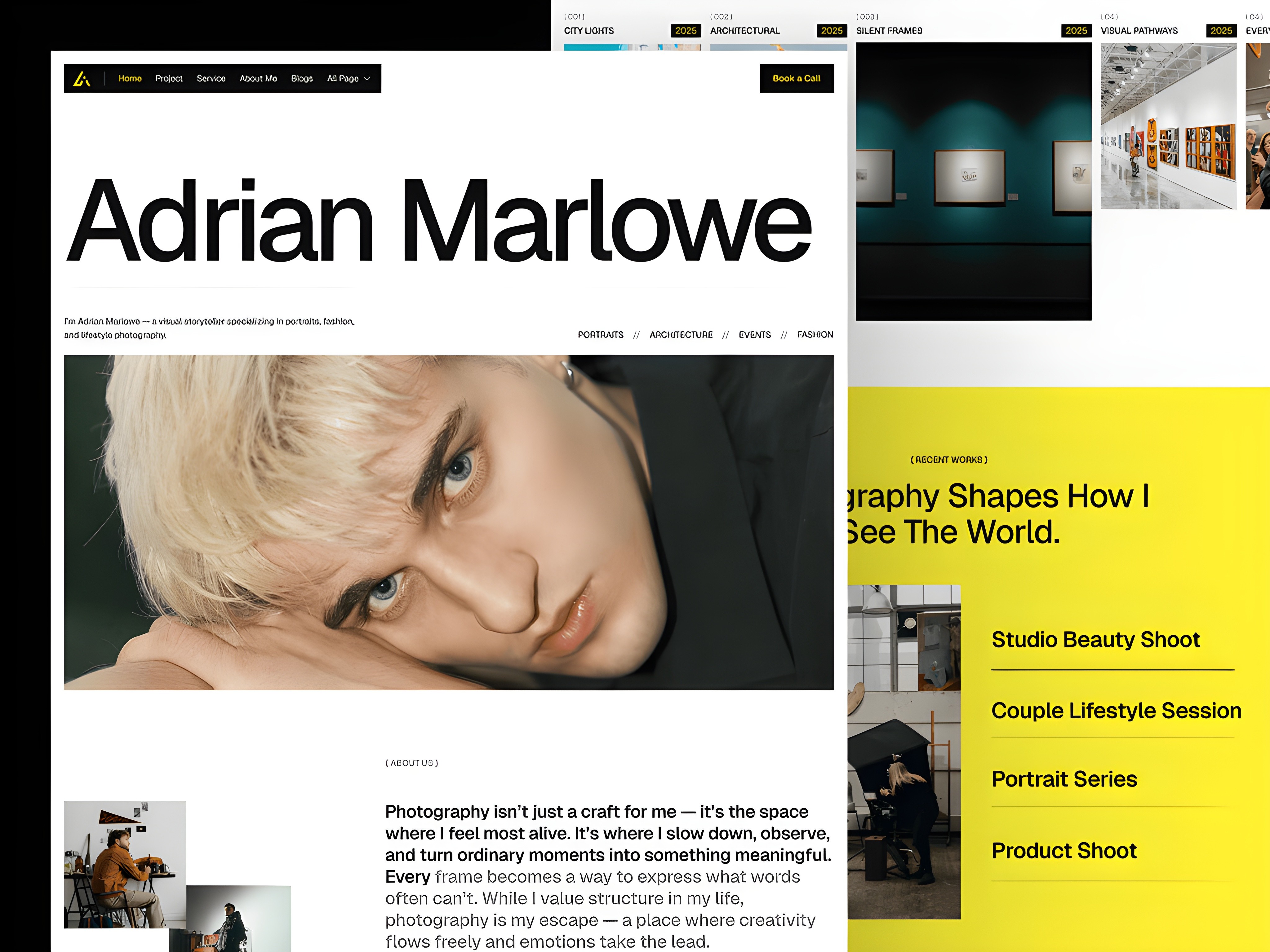
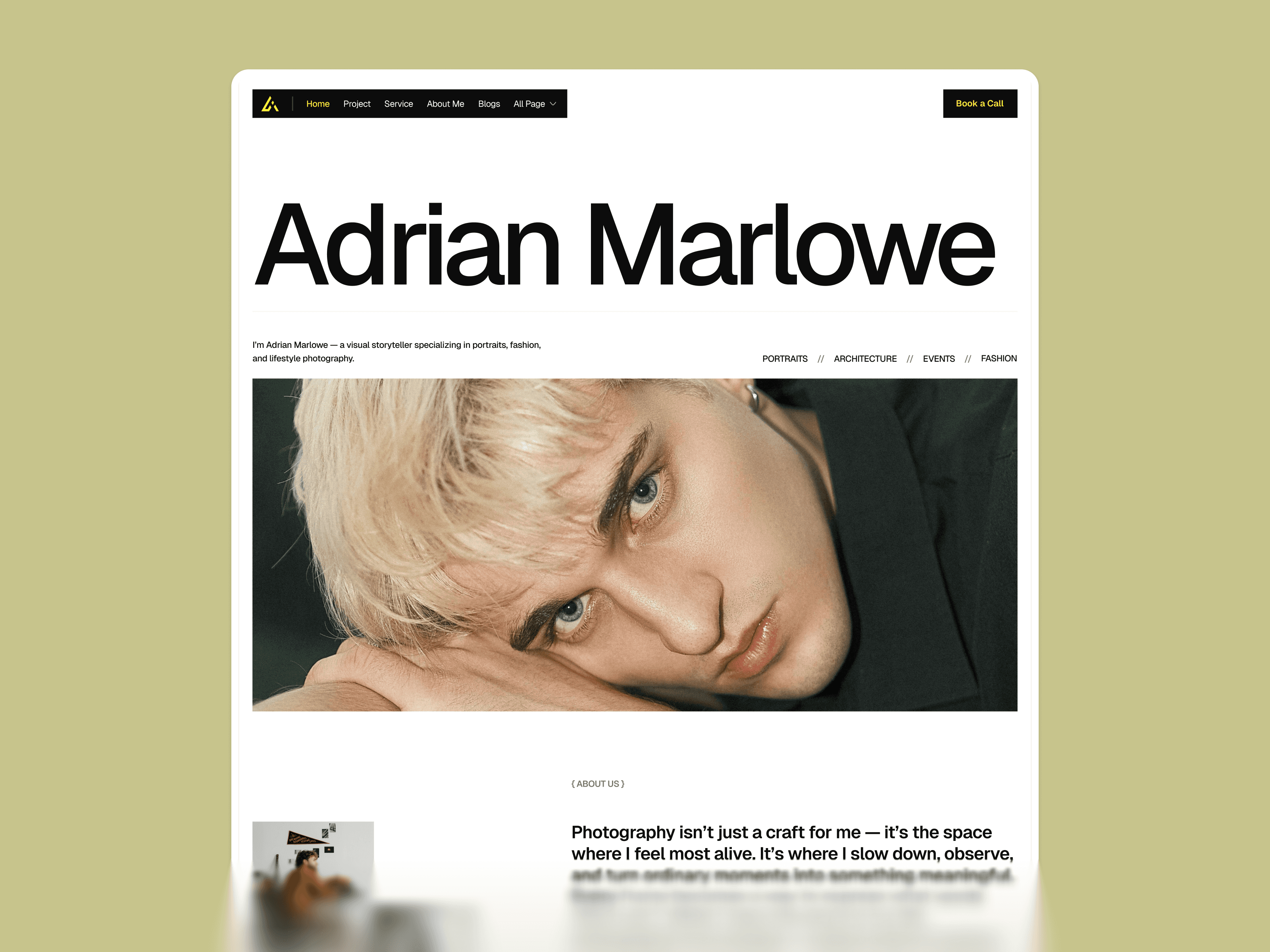
Marlowe is the only template in the collection purpose-built for photography portfolio presentation — with large-format primary images, session category navigation, and editorial magazine-style grid structure that reflects how photography clients actually evaluate photographers. The numbered editorial pagination gives the site the feel of a curated publication rather than a scrollable image dump.
Best for: Fashion and editorial photographers, portrait and commercial photographers, photography studios, visual lifestyle creatives.
Why it stands out: Built around how photography clients evaluate photographers — large images first, category browsing second, contact when they have found what they are looking for.
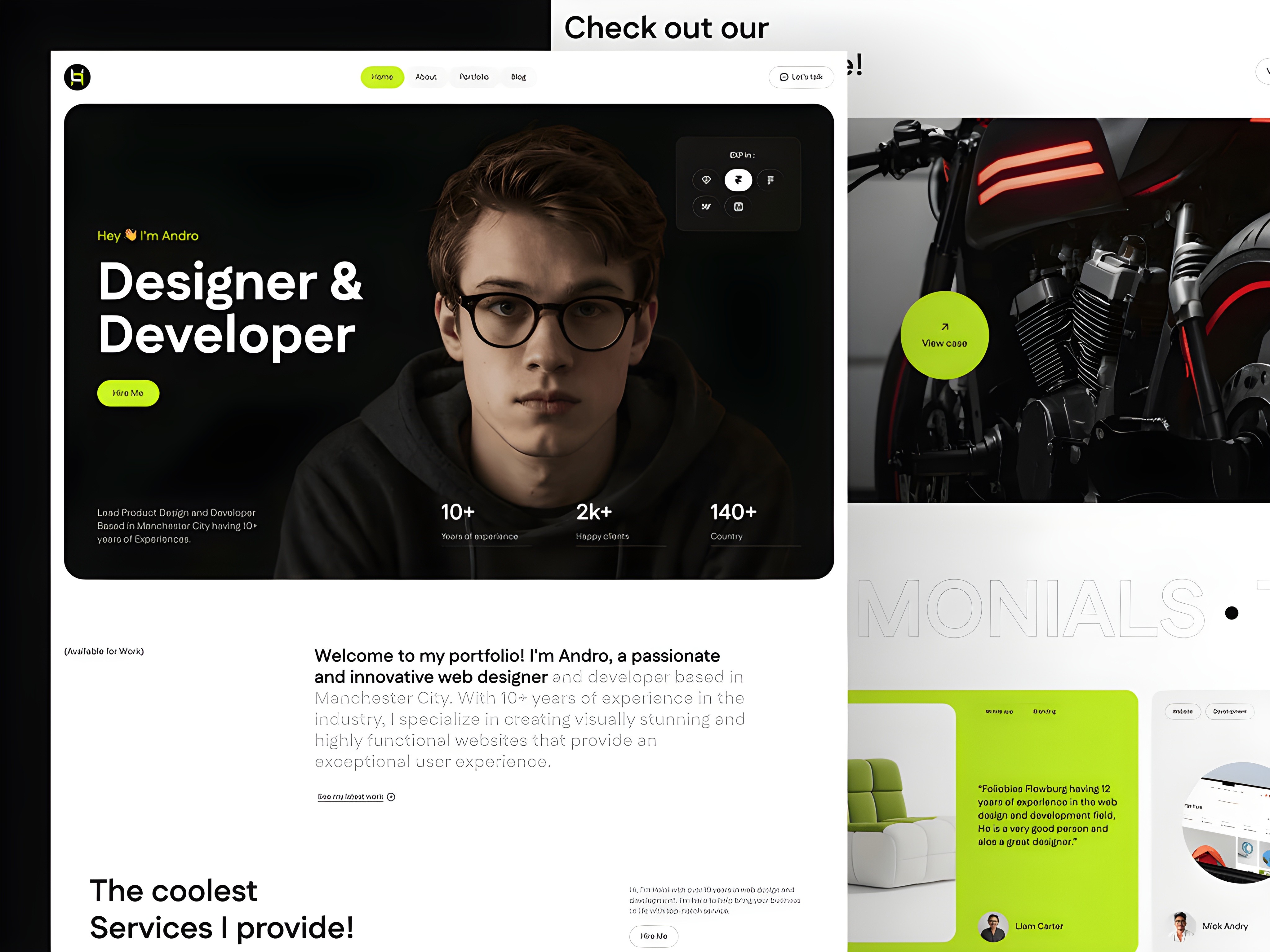
Portox is the strongest free portfolio template in the Pentaclay library — a designer and developer dual-skill portfolio with experience counters, a personal introduction section, and a UX/UI work showcase. At free, there is no reason not to start with it if the designer-developer positioning matches your work.
Best for: UX/UI designers, web designers who also develop, front-end developers with strong design skills, creative technologists.
Why it stands out: The best free portfolio template currently available for Framer — not a stripped-down paid template but a genuinely complete portfolio structure.
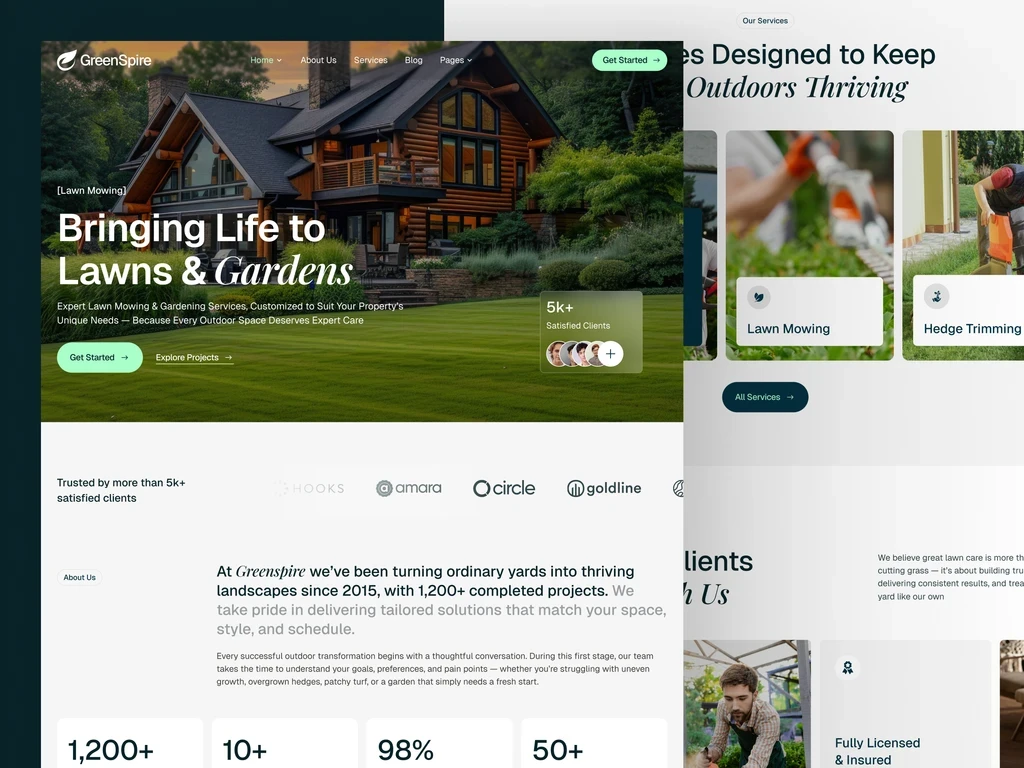
GreenSpire is the most distinctive portfolio template in the collection — purpose-built for landscape gardening, lawn care, and outdoor service businesses where portfolio project photography is the primary sales tool. The business metrics section, service breakdown, and gallery structure are all built for a service business where before-and-after project proof converts clients.
Best for: Landscape gardening businesses, lawn care companies, outdoor design services, sustainable garden designers.
Why it stands out: There are almost no professionally designed Framer templates for outdoor service businesses — GreenSpire fills that gap with a complete service business structure.
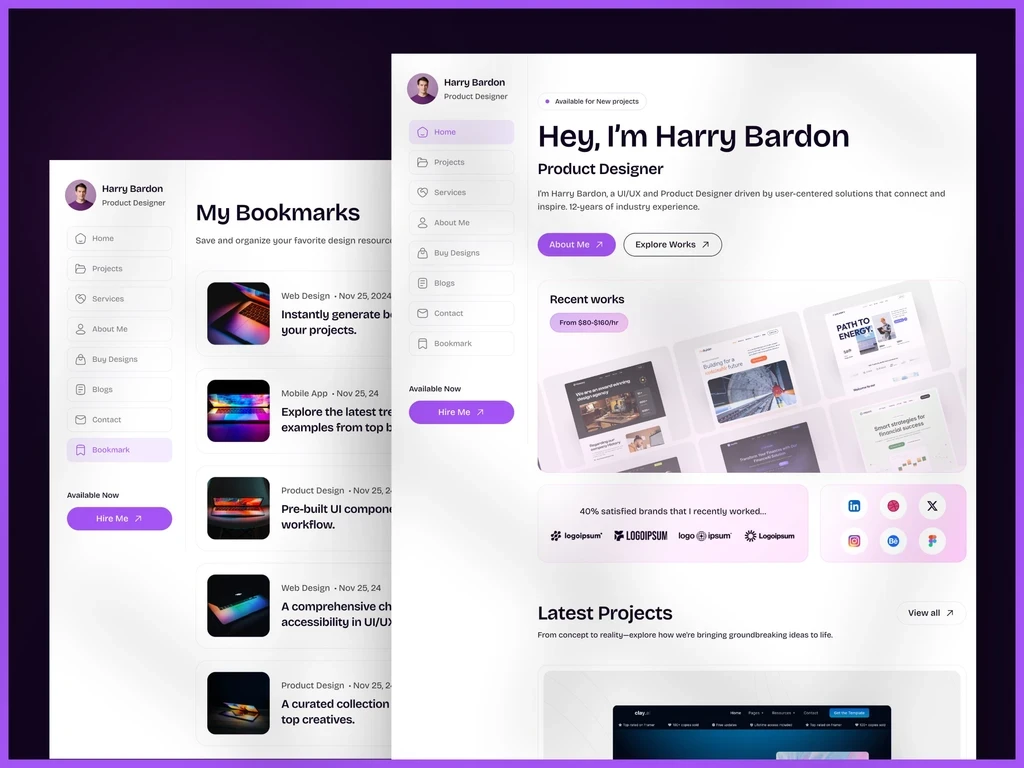
Hyperfolio is the most UX-forward portfolio template in the collection — built around the information architecture a product designer would design. The sidebar navigation, availability indicator, tool showcase bar, and "Recent Works" section with direct project links demonstrate UX thinking before a visitor reads a single case study, which is the most important credibility signal for a design-literate audience.
Best for: Product designers, UX/UI designers at mid-to-senior level, interaction designers, design system specialists.
Why it stands out: The portfolio structure itself is a UX demonstration — communicating design thinking to evaluators who assess a designer's portfolio on structure as much as visual output.
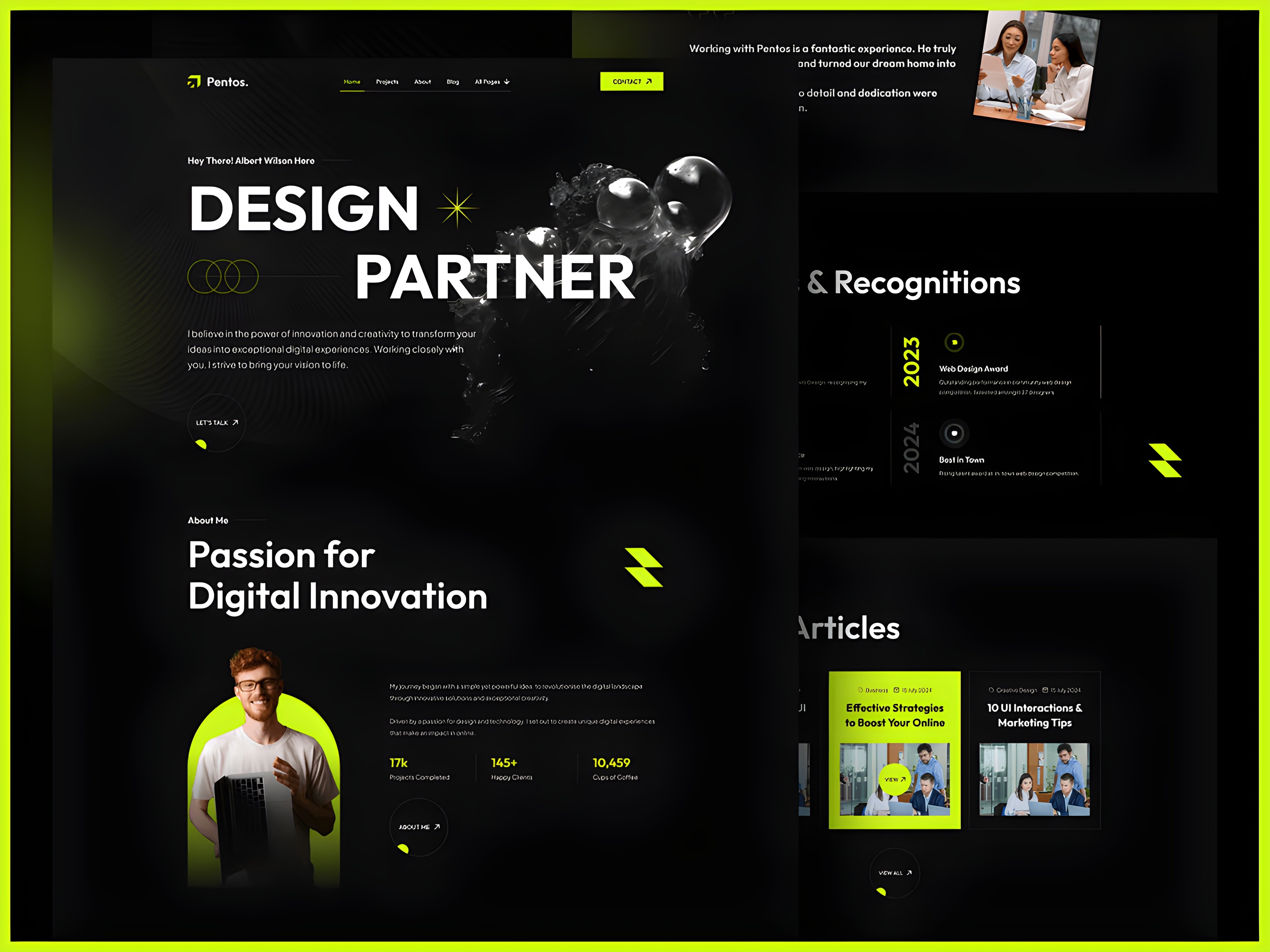
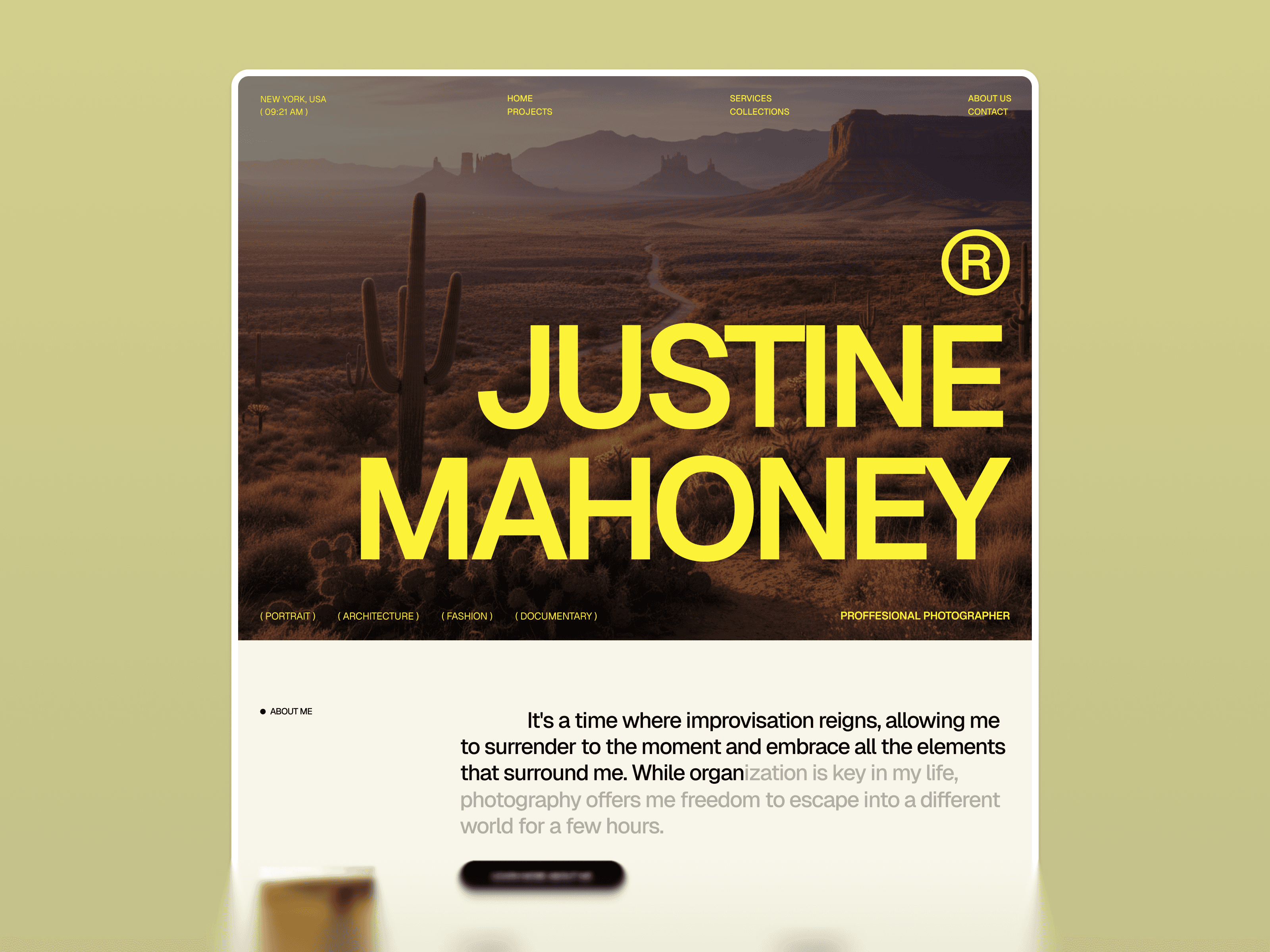
Pentos is the most visually bold free portfolio template in the collection — built for senior creatives with a defined personal brand who want a free template that reflects their aesthetic rather than constraining it. The "DESIGN * PARTNER" headline, neon yellow accents, and dark design system give it a distinctive visual identity that free templates rarely achieve.
Best for: Creative directors, senior designers, digital artists, motion designers, brand designers with a defined aesthetic identity.
Why it stands out: Free with genuine design quality — it does not look like a free template, making it the most respectful free starting point for a senior creative who already knows who they are.
Framer Business Templates
Business templates cover the wide range of industry-specific and service-based websites that do not fit neatly into agency, SaaS, or startup categories. From legal firms and dental clinics to restaurants and transportation services, these templates are purpose-built for the specific trust signals, service presentations, and conversion flows of each industry.
Statify — analytics, consulting, and data-focused businesses. Clean data-friendly layouts that present complex business information in a structured and readable format.
Justlaw — law firms and legal professionals. Trust-first layout with service pages, testimonials, and credibility-building structure designed for high-stakes professional service decisions.
Laundy — small service businesses including laundry, cleaning, and home services. Simple, practical structure with service listings, pricing, and contact for businesses that need to launch quickly.
SeniorNest — elderly care and senior living services. Trust-forward design with clear service descriptions and contact sections built for the specific sensitivities of healthcare-adjacent industries.
Dentistry — dental clinics and healthcare providers. Professional patient-facing structure with appointment sections, service pages, and trust-building layout.
MetroRide — transportation services and mobility businesses. Functional service and booking layout for ride, logistics, and transport companies.
Dinevo — restaurants and food service businesses. Visual menu presentation, gallery layouts, and reservation-focused design that prioritizes food photography and dining experience.
Roofora — construction and home service companies. Service showcase, project portfolio, and lead generation structure for contractors and builders.
Ecoscape — local service businesses including landscaping and outdoor maintenance. Service sections and gallery layouts for approachable, locally-focused business presentation.
Nexous — SEO, digital marketing, and online growth consultancies. Structured service pages, case studies, and lead capture sections for digital service experts.
Dwell Space — real estate agencies and property consultancies. Property showcase sections, image galleries, and inquiry-focused layouts for property and space professionals.
Pro Builder — construction companies and real estate developers. Project showcase and service layouts for businesses that need to highlight both completed work and ongoing capabilities.
Ignitx — innovation-driven businesses and startup consultancies. Modern storytelling layouts for forward-thinking advisors and innovation-focused service firms.
Livepower — fitness, performance, and coaching businesses. High-energy design with service sections and CTA-focused layouts for coaches and performance professionals.
Recroot — recruitment agencies and HR consultancies. Job listing sections, service pages, and candidate-client communication layouts for talent acquisition specialists.
Digiket — digital marketing consultants and online growth specialists. Service breakdowns, portfolio sections, and lead generation layouts for consultants operating in online industries.
Solarify — renewable energy and sustainability businesses. Industry-focused design with trust-building elements for energy consultants and green technology companies.
Zynqehouse — ecommerce brands and online stores. Product-focused gallery, conversion-friendly layouts, and mobile-optimized shopping experience for DTC and digital product brands.
HubStore — membership platforms and digital product ecosystems. Content-focused sections, resource listings, and subscription-oriented layouts for creators and educators building gated platforms.
How to Choose the Best Framer Template for Your Business
With dozens of options across every category, the decision comes down to four factors applied in sequence.
Step 1 — Define your primary conversion goal. Are you driving trial signups, demo requests, client inquiries, portfolio views, or waitlist joins? Every template is structurally optimized for one or two of these goals. Choosing a template optimized for your specific goal is more important than any design preference.
Step 2 — Match your buyer. Who is making the decision to engage with you? A B2B enterprise buyer evaluates on completely different signals than a freelance design client. A fintech buyer applies more skepticism than a startup founder. The template's structural architecture needs to match the way your buyer actually makes decisions.
Step 3 — Evaluate the content fit. Does the template's section structure match what you actually have to say? A template with a large case study section is useless if you do not have case studies. A CMS blog section is a waste if you are not investing in content marketing. Choose a template whose section structure you can populate authentically from day one.
Step 4 — Confirm CMS needs. If you plan to grow through content marketing, portfolio updates, or product changelog — confirm the template has Framer CMS collections pre-configured for your content type. Adding CMS to a template that was not built for it requires significant structural work.
Common Mistakes to Avoid When Choosing a Framer Template
Choosing based on aesthetics alone. A visually impressive template that is structured for the wrong conversion goal will consistently underperform a simpler template built for your specific use case. Structure beats aesthetics in conversion performance every time.
Ignoring mobile responsiveness. A significant portion of your traffic — especially from social, ads, and referrals — arrives on mobile. Templates that look exceptional on desktop but feel cramped or broken on mobile are actively losing you conversions from high-intent visitors.
Overlooking content strategy fit. Even the best template cannot compensate for weak or misaligned content. Before choosing a template, confirm that its section structure matches what you actually have to say — not what you aspire to have eventually.
Underestimating CMS needs. If you plan to publish regular content — blog posts, case studies, product updates, portfolio entries — confirm the template has CMS infrastructure built in. Adding CMS to a template retrospectively is significantly more work than starting with one that has it pre-configured.
Treating the template as the finished product. A template is a starting point, not a destination. The customization work — updating copy to reflect your specific positioning, swapping images for your actual work, adjusting brand colors and typography — is where the template becomes your website. Budget time for that customization pass before your launch date.
Frequently Asked Questions
What are the best Framer templates overall?
The best template depends entirely on your use case. For SaaS: Arcedia, ClayAI, EventIQ. For agencies: Rendani, Converra, Synco. For startups: Systema, Redient, Banki. For AI products: Chatpilot, Gilberto, Saatosa. For portfolios: Marlowe, Hyperfolio, Portox. For free starting points: Portox, Pentos, Codot. Each template in the Pentaclay library is documented with its specific use case, primary buyer, and structural strengths — so you can match template to goal rather than choosing by design preference alone.
Are Framer templates SEO-friendly?
All Pentaclay Framer templates are built with clean HTML structure, semantic heading hierarchy, and performance-optimized code. Framer gives you full control over title tags, meta descriptions, canonical URLs, and Open Graph fields at the page level. Templates with Framer CMS blog sections give you the content marketing infrastructure to build organic authority from launch day. For SaaS and AI products specifically, organic content is the most cost-effective long-term acquisition channel — choosing a template with CMS infrastructure from the start is the right long-term investment.
Can I use Framer templates for client websites?
Yes — with a commercial license. Single-template purchases cover one website. If you build websites for clients regularly, the All Access plan at $169/year covers unlimited websites across the entire Pentaclay library — making the per-project cost significantly lower than individual template purchases and eliminating the need to re-evaluate licensing on every new project.
Do I need a Framer subscription to publish?
Yes — a Framer hosting plan is required to publish on a custom domain. Framer's Basic plan ($15/month) covers a single site. The CMS plan ($23/month) is recommended for templates with dynamic blog, portfolio, or changelog sections. The template purchase is a one-time cost separate from the ongoing hosting subscription.
How long does it take to customize and launch a Framer template?
For a focused customization pass — updating copy, swapping images, adjusting brand colors and typography — most founders and teams report 4 to 8 hours to a publish-ready state. A full customization including new sections, additional pages, Framer CMS configuration, and custom domain setup typically takes a weekend. No developer required.
What is the difference between a single license and All Access?
A single-template license covers one website at a one-time price ranging from free to $99. The All Access plan at $169/year covers unlimited websites across the entire Pentaclay library — 50+ Framer templates, 15+ Webflow templates, and 60+ Figma templates. All Access is the right investment for agencies managing client sites, founders building multiple products, or studios that want unlimited access to the full library as it grows.
Do I need a Framer subscription to publish?
Yes — a Framer hosting plan is required to publish on a custom domain. Framer's Mini plan ($5/month) covers a simple personal site. For portfolio sites with CMS (for adding new projects), the Basic plan ($15/month) is recommended. The template purchase is a one-time cost; the Framer hosting plan is the ongoing subscription.
Are there free Framer templates available?
Yes — Portox, Pentos, and Codot are all completely free with no purchase required. Portox is built for designer-developer dual-skill portfolios. Pentos is built for senior creatives with a defined personal brand. Codot is built for developer studios and technical agencies. All three are fully customizable in Framer's visual editor and include the core sections a professional website needs.
The Pentaclay Framer template library covers every major website category — SaaS and AI products, creative and performance agencies, early-stage startups across every vertical, portfolio and personal brand sites, and business templates across dozens of specific industries. Every template is documented with its specific use case, primary buyer, and structural strengths so you can make an informed decision based on your actual goals rather than design preference alone.
Three templates are completely free. Paid options range from $49 to $99 for a single-site license. All include live previews of every page before purchase. Browse by category above, compare by use case, and launch when you are ready — or unlock unlimited access to the full library with the All Access plan at $169/year.
👉 Browse all Framer templates · See best Framer SaaS templates · See best Framer agency templates · See best Framer AI templates · See best Framer startup templates